

How to Build a Real Business with a Community Platform for Creators

Table of Contents
A community platform for creators is your own digital headquarters. It's not just another social media profile; it's a dedicated space where you combine your content, conversations, and sales under one roof. This guide provides a step-by-step plan to move beyond social media and build a stable business around your passion.
What is an Owned Community Platform?
Building an audience on social media is like building on rented land. You invest years of work, but your reach and even your account's existence depend on algorithms and rules you don't control. A single policy change can erase your efforts overnight.
A dedicated community platform changes the game. You stop renting an audience and start owning the relationships with your most dedicated followers. You move from being just another creator in a crowded feed to becoming the leader of a focused group that values your work. This direct connection is the foundation of a predictable, sustainable business.
Why an Owned Platform is a Smarter Business Model
When you own the platform, you control the experience and your income. You decide how to connect with your members and how to earn money from your work.
Here’s what that means in practice:
- Step 1: Get Direct Audience Access. Stop fighting algorithms. When you post an announcement, new content, or an offer, you can reach 100% of your members directly. No more guessing if your followers will see your post.
- Step 2: Take Control of Monetization. You decide how you earn. Offer subscriptions, sell one-off courses, or gate exclusive content. You set the prices and keep more of the revenue, without a platform taking a huge cut.
- Step 3: Foster Deeper Connections. Create a space for real conversations without the ads, noise, and distractions of social media. This turns passive followers into active members who are invested in you and your brand.
This isn't just about getting more views. It's about transforming followers into paying members who feel like they belong.
The All-in-One Toolkit Explained
Imagine running your business with a dozen different tools that don't communicate. You're juggling an email service, a course platform, an event tool, and a chat app. It's chaotic for you and confusing for your audience.
A community platform for creators combines these scattered tools into one streamlined system. It’s your classroom, event stage, and members' lounge, all in one place.
For example, a platform like Kampunity integrates a course builder, event calendars, discussion forums, and payment processing. This simplifies your workflow and creates a seamless experience for your members. They can watch a lesson, join a discussion about it, and then sign up for a live workshop—all without leaving your branded space. This is the most effective way to build a dedicated, paying community and gain full control over your business.
Moving Beyond the Limits of Social Media
Building your entire creator business on social media is risky. The platform owner can change the rules, limit your reach, or suspend your account without warning. For creators, this is a constant threat.
A sudden algorithm change can crush your engagement. Platform censorship can get your content removed. You are always competing for attention against a flood of ads and other content.
The Dangers of Building on Rented Land
Consider a creator who earns income from brand deals shared with their followers. They could wake up to find a new platform policy has flagged their content, shutting down their primary revenue stream instantly. This is a common reality for many creators.
This is where a community platform for creators provides stability. It lets you move your business off rented land and onto a property you own, giving you a direct, unfiltered connection to your most loyal supporters.
This diagram illustrates how a community platform becomes the central hub for your entire business.
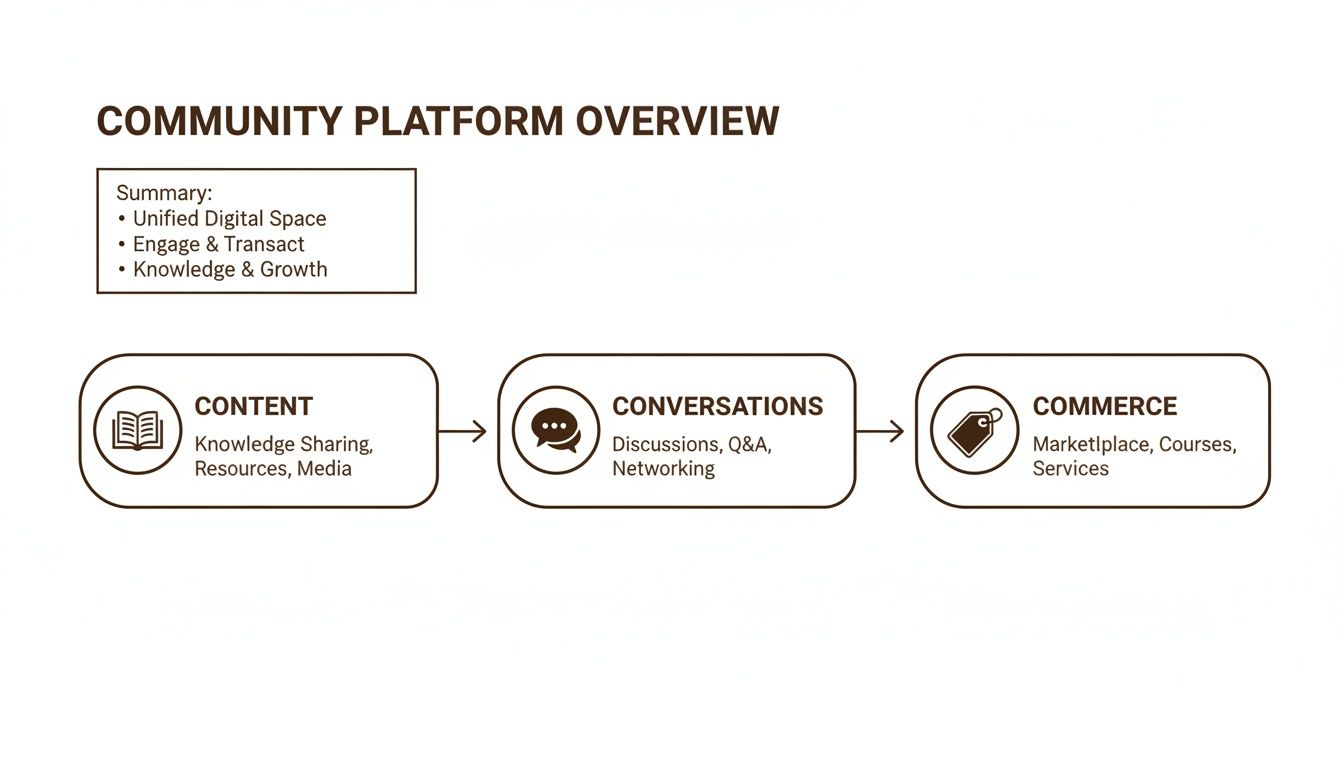
By integrating your content, conversations, and commerce, you build a powerful, self-sustaining ecosystem. The shift from "follower" to "member" fosters deeper relationships and a sense of belonging that is nearly impossible to achieve on social media.
Owning Your Audience Relationship
The creator economy has grown into a USD 203.6 billion industry and is projected to more than double by 2027. This growth is driven by over 200 million creators, but most still rely on inconsistent income from ads and sponsorships. A dedicated platform like Kampunity shifts the focus to your own products, such as courses and memberships, by providing the tools needed to convert a casual audience into paying members. You can find more insights about the creator economy's impressive growth here.
Building on your own platform means you own the data, control the experience, and set the rules. Your business becomes algorithm-proof.
The difference is clear when you compare the two approaches.
Social Media vs. Owned Community Platform: A Practical Comparison
This table shows the practical differences in where you invest your effort and the results you get.
| Feature | Social Media Platforms | Owned Community Platform |
|---|---|---|
| Audience Access | Filtered by algorithms; you reach a small fraction of your followers. | Direct and unfiltered; reach 100% of your members with every post. |
| Monetization | Limited to ads, sponsorships, or platform tools with high fees. | Flexible and direct; offer subscriptions, courses, and content with full control over pricing. |
| Data & Analytics | Basic insights provided by the platform, with limited access to user data. | Deep, granular analytics on member behavior, giving you actionable insights to grow. |
| Branding & Experience | Your brand is confined within the platform's layout and rules. | Fully customizable; create a branded, distraction-free environment that is uniquely yours. |
| Community Depth | Superficial interactions like likes and comments compete with constant noise. | Fosters deep, meaningful connections through structured discussions and exclusive events. |
While social media is excellent for discovery, an owned platform is where you build a durable business. It’s the difference between shouting into a crowd and having a meaningful conversation with the people who value your work most.
Essential Features Your Community Platform Needs
Choosing the right community platform for creators is like choosing the foundation for a house. A solid foundation supports long-term growth, while a weak one leads to constant problems. Not all platforms are equal, and the right features are critical for managing and monetizing your audience effectively.
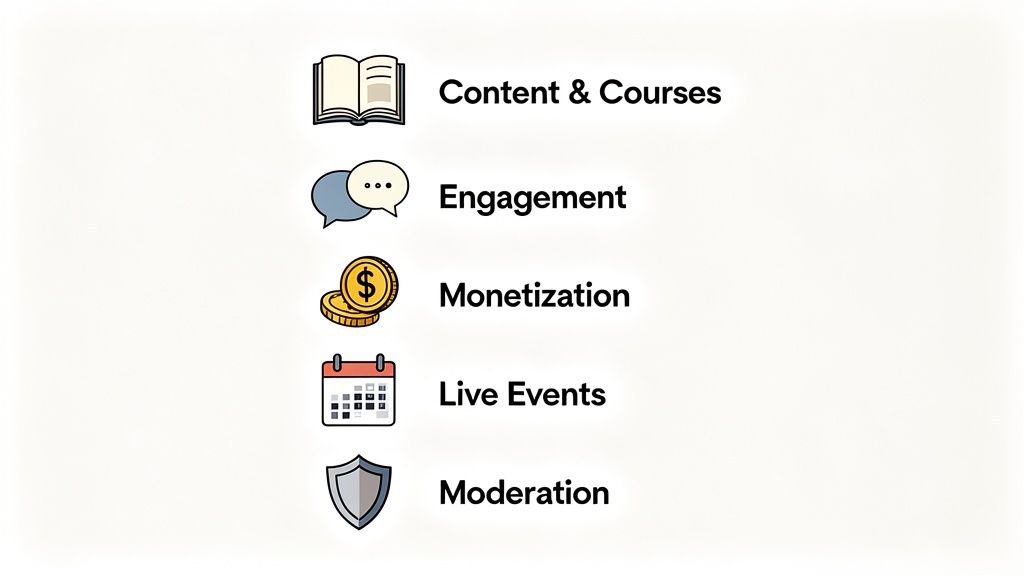
These features are your essential toolkit for turning passive followers into a thriving community business.
Content and Learning Tools
Your community is built on the value you provide through content. Your platform must make it simple to organize and deliver your expertise. A basic forum isn't enough.
A built-in course builder is essential for creating structured learning paths. A good one lets you:
- Host multimedia lessons: Easily upload videos, PDFs, and audio files.
- Create quizzes and assignments: Make learning interactive and track member progress.
- Drip content over time: Release lessons on a schedule to keep everyone on the same page.
Without these integrated tools, you're forced to use a separate course platform, creating a clunky experience for your members.
Member Engagement Features
A community thrives on conversation. Engagement features transform a static content library into an active hub, giving members a reason to return.
Threaded discussions are crucial for keeping conversations organized and easy to follow. Direct messaging allows members to build one-on-one connections, strengthening the community.
Gamification is a powerful tool for boosting participation. Features like points, badges, and leaderboards tap into our natural desire for achievement and recognition.
Example: A fitness coach could award a "Consistency Champion" badge to members who log workouts for 30 consecutive days. This small reward motivates both the recipient and the rest of the community, turning passive members into active participants.
Flexible Monetization Options
You deserve to be paid for your work, and your platform should offer multiple ways to earn income. Relying on a single revenue stream is risky.
Flexibility allows you to meet members where they are. Someone not ready for a monthly subscription might purchase a one-off workshop. The best platforms include:
- Subscriptions and Memberships: Create recurring revenue with different access tiers (e.g., Bronze, Silver, Gold).
- One-Time Purchases: Sell standalone products like digital downloads, individual courses, or event tickets.
- Content Gating: Lock specific channels, courses, or resources behind a paywall for premium members.
Integrated tools help you avoid third-party transaction fees and keep the entire experience under your brand. Explore these strategies further in our articles on community monetization.
Live Event Management
Live events—like weekly Q&As, expert workshops, or virtual meetups—create an energy and sense of exclusivity that pre-recorded content can't match.
Your platform should simplify event hosting. Look for a built-in calendar, integration with video tools like Zoom, and automated email reminders to boost attendance. A well-run live event can become a cornerstone of your community's value.
Robust Moderation Tools
As your community grows, maintaining a safe and positive environment becomes a top priority. Without effective moderation tools, spam and negativity can take over.
You need the ability to assign roles (admins, moderators), set permissions for member groups, and easily remove harmful content or users. These tools are essential for protecting the culture you've built. With the global creator marketing platform market valued at USD 31.42 billion, the opportunity is massive. Discover more insights about creator economy projections on Digiday.com.
How to Choose the Right Platform for Your Brand
Selecting a community platform is a critical business decision. It's not about finding the tool with the most features; it's about finding a partner that understands your vision and can grow with you. To make the right choice, you need to ask practical questions.
Use this checklist to ensure you build your community on a solid foundation.
Step 1: Analyze the Pricing Structure
The sticker price rarely tells the full story. Many platforms have hidden fees and pricing tiers that increase as you grow. A deal that looks good with 100 members can become a financial burden at 10,000.
Ask these specific questions:
- What are the transaction fees? A 5-10% fee on every sale adds up quickly and reduces your profits.
- Does the price increase with more members or revenue? Avoid models that penalize your success. A flat monthly fee with a low, transparent transaction percentage is more predictable.
- Are essential features locked behind expensive plans? Some platforms force you to upgrade for basic features like a custom domain or live events.
A platform with clear, predictable pricing, like Kampunity, allows you to focus on creating content instead of worrying about surprise costs.
Step 2: Evaluate Scalability and Performance
Your community will grow, and your platform must handle that growth without issues. A system that works for a small group can become slow and unstable with thousands of users. This creates a poor user experience that can drive members away.
Assess the platform's ability to scale. Can it handle a surge of users during a live event? Is its infrastructure built to manage a large content library and constant member discussions without lag? A truly scalable community platform for creators is designed for growth from the start, ensuring a smooth experience for all members.
Step 3: Assess Analytics and Member Insights
You can't improve what you don't measure. Without good data, you're just guessing what your members want. Solid analytics are essential for understanding your community and making informed decisions.
Your platform's analytics dashboard should be your command center, providing clear, actionable insights into member activity, content performance, and overall community health.
Look for a platform that provides data on:
- Member Engagement: Identify your most active members and popular conversations.
- Content Consumption: See which courses members are completing and what content they engage with most.
- Revenue Metrics: Track your monthly recurring revenue (MRR) and identify your bestselling products.
This data is crucial for optimizing your strategy. For a detailed comparison, our guide on the best online community platforms analyzes the analytics offerings of different providers.
Step 4: Choose All-In-One vs. Stitched-Together Solutions
Decide whether you want a single, integrated platform or are willing to piece together multiple tools. Juggling separate platforms for courses, payments, events, and discussions creates a disjointed experience for members and a management headache for you. For solo creators, the simplicity of a central hub is invaluable, a lesson often learned when selecting the best website builders for freelancers.
An all-in-one platform simplifies operations, reduces hidden costs, and provides a seamless, branded home for your members. When everything is in one place, members can easily move from a course to a related discussion to a live Q&A, all within your ecosystem. This unified experience strengthens your brand and increases member retention.
A Look Inside the Kampunity Platform
Theory is helpful, but seeing a community platform for creators in action makes the benefits clear. Let's look at how a platform like Kampunity solves real-world problems for creators.
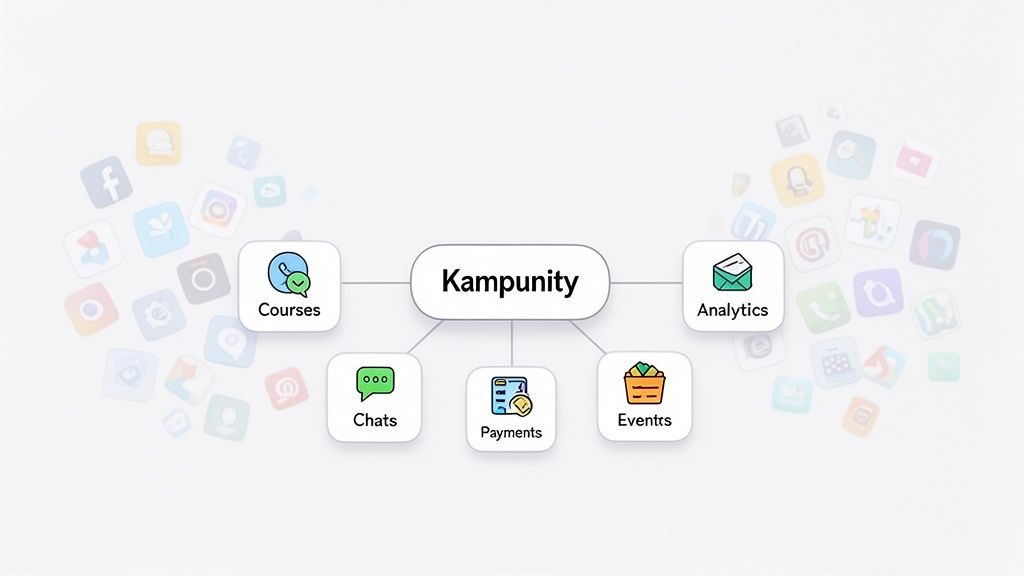
The alternative is patching together separate tools like Discord for chat, Teachable for courses, and Eventbrite for events. Kampunity integrates all these functions into one seamless system. This isn't just about convenience; it's about providing a professional experience that keeps members engaged.
From Juggling Tools to a Unified Hub
Problem: A fitness coach uses multiple platforms. Her clients have one login for workout videos, another app for the group chat, and must search their email for the weekly Zoom link. This is confusing for clients and a logistical nightmare for the coach.
Solution: With Kampunity, her entire business is in one branded space. A client can finish a course module, ask a question in a related discussion channel, and check the community calendar for the next live coaching call—all without leaving her platform.
This integrated system removes friction and keeps members focused on the value you provide.
Real-World Scenarios on Kampunity
Here are two practical examples of how creators use Kampunity's features to build profitable communities.
Scenario 1: The Industry Expert and Tiered Subscriptions
An industry expert wants to create recurring revenue. Using Kampunity, she sets up three membership tiers:
- Bronze Tier ($10/month): Access to a private discussion forum and a weekly members-only newsletter.
- Silver Tier ($49/month): Everything in Bronze, plus an exclusive monthly live Q&A and a library of past session recordings.
- Gold Tier ($99/month): All of the above, plus access to her premium course and a private channel for direct feedback.
Kampunity handles payment processing and automatically assigns permissions based on each member's tier. This allows her to build a predictable income with scalable value, all without manual administrative work.
Scenario 2: The Fitness Coach and Gamification
A fitness coach launches a 12-week challenge. To keep members motivated, she uses Kampunity’s gamification tools. She creates a system where members earn experience points (XP) for completing lessons, logging workouts, and encouraging others in the community feed.
As members level up, they automatically unlock new content, like bonus recipes or advanced workout guides. This turns passive learning into an active, rewarding experience, boosting course completion rates and long-term engagement.
She also uses the built-in course builder to structure her video lessons and add progress-checking quizzes. To learn more about setting up these spaces, see our guide on Kampunity’s community channels.
Built for Creator Growth and Safety
With over 200 million creators competing for attention, a professional experience is key. Kampunity combines courses, media-rich chats, and flexible payment options under one roof. Since digital products can have 70-90% profit margins, an integrated system that captures that value is essential. You can explore more creator economy trends and statistics to understand the full potential.
As your community grows, safety is paramount. Kampunity provides robust moderation tools to maintain a positive environment. This combination of powerful engagement features, business tools, and a secure environment makes it a true all-in-one solution for creators ready to build a sustainable business.
Frequently Asked Questions
Moving to an owned community platform is a big decision. Here are answers to the most common questions creators ask when choosing a community platform.
How Much Does a Community Platform Actually Cost?
The total cost often includes more than just the monthly fee. Hidden transaction fees can significantly impact your earnings.
Many platforms advertise a low monthly price but take a large percentage of your sales—sometimes up to 10%. This model penalizes your success; the more you earn, the more they take.
A fairer model is a transparent monthly fee plus a small transaction percentage (e.g., 1-2%) to cover payment processing. This approach is predictable and allows you to keep more of your revenue.
Action Step: Before choosing a platform, create a simple spreadsheet. Estimate your monthly sales and member count, then calculate the total fees you would pay on different platforms. This exercise can save you thousands of dollars and ensure your platform supports your growth.
Look for a platform with simple, clear pricing. Avoid hidden fees or complex tiers that lock essential features behind expensive plans.
Is It Hard to Move an Existing Community?
Migrating a community from a Facebook Group or Discord server can seem daunting, but a strategic plan makes it manageable. The key is to frame the move as an exciting upgrade for your members.
Instead of a simple announcement, create a narrative around the new, exclusive benefits, such as a cleaner, ad-free environment and better-organized content.
Here is a step-by-step plan for a smooth transition:
- Build Hype: Tease the "new home" for your community a few weeks in advance. Share sneak peeks and highlight the improved experience.
- Offer an Incentive: Encourage early adoption with a special "founding member" badge, a limited-time discount, or exclusive access to new content.
- Provide Clear Instructions: Create a simple guide—a short video or a one-page PDF—showing members exactly how to sign up.
- Run a Launch Event: Host an exclusive live Q&A or workshop inside the new community to get everyone engaged from day one.
The goal is to build momentum and show your members why the new space is better. This will help you bring your core community and its culture with you.
Can I Really Earn a Living with a Community Platform?
Yes. For many creators, an owned community platform is what turns a side hustle into a sustainable career. It allows you to shift from relying on unpredictable ad revenue to building a reliable income stream that you control.
Successful creators build multiple income streams within their community. This diversifies your revenue and offers members various ways to support you.
Here are three proven methods:
- Tiered Memberships: Offer different levels of access. A basic tier might include community chat, while a premium tier could unlock exclusive courses and live coaching. This creates a stable, recurring revenue base.
- One-Off Product Sales: Sell digital guides, masterclass recordings, or tickets to virtual events. This is ideal for members who aren't ready for a monthly subscription.
- Exclusive Content Drops: Gate your best content—a bonus podcast, a behind-the-scenes video, or an expert tutorial—behind a paywall. This creates exclusivity and a clear reason for members to pay.
As you develop your income streams, optimize your presence on other platforms as well. For example, knowing how to monetize YouTube Shorts can provide an additional revenue source that complements your community earnings. The real power lies in owning the audience relationship and having the tools to sell directly to them.
Ready to build a thriving, profitable community without juggling a dozen different tools? Kampunity provides everything you need—courses, chats, events, and monetization—all in one place. Start building your community today!