

What Are Learning Communities and How Do They Work?

Table of Contents
A learning community is a group of people who learn together about a shared interest. But it's not just a course—it's an interactive space where members learn from the expert, the material, and each other through active collaboration.
Think of it less like a lecture hall and more like a workshop. Instead of information flowing one way (from creator to student), learning communities thrive on multi-directional conversation, peer support, and shared progress.
The Core Idea of a Learning Community
A true learning community is built for collective growth. Members aren't passive consumers; they are active participants who ask questions, share experiences, and solve problems together.
Three key elements make this model work:
- A Shared Goal: Everyone is there for a specific reason—to master a new skill, launch a business, or learn to code. This common purpose unites the group.
- Active Participation: Members are expected to contribute. This means asking questions, answering others, and sharing what they’ve learned, shifting them from passive students to active collaborators.
- Peer-to-Peer Support: A huge part of the value comes from other members. This is the foundation of social learning—recognizing that peers are one of your greatest resources.
Learning Community vs. a Typical Online Audience
To understand what makes a learning community different, compare it to a traditional online audience, like your blog readers or social media followers. The key difference is the shift from passive consumption to active, collaborative learning.
Here's a practical breakdown:
| Characteristic | Traditional Audience (e.g., Blog Readers) | Learning Community (e.g., Kampunity Group) |
|---|---|---|
| Interaction | One-way (creator to audience) | Multi-way (creator-member & member-member) |
| Goal | Consuming information | Achieving a specific outcome or skill |
| Member Role | Passive consumer | Active collaborator |
| Value Source | From the creator's content | From the creator, content, and peers |
This collaborative approach has reshaped online education. The Massive Open Online Course (MOOC) market grew to over 220 million students by leveraging community features like discussion forums and peer-graded assignments.
The results are clear: studies show that adding an interactive community can increase course completion rates by up to 20%. You can discover more insights about EdTech growth and see the data for yourself.
A learning community creates accountability and shared momentum that you can't get from consuming content alone.
The Five Pillars of a Strong Learning Community
A thriving learning community doesn’t happen by accident. It's intentionally designed around five core pillars that create a space where people feel motivated and supported. Getting these right is the first step toward building a community that delivers real results.
Shared Purpose and Learning Path
It all starts with a clear, shared purpose. This is the group's "why." For example, the goal might be "Master Python for data analysis," "Launch a profitable Etsy shop," or "Learn to paint with watercolors." This specific goal prevents discussions from drifting and keeps members focused.
A purpose needs a structured learning path—a step-by-step roadmap showing members how to achieve the goal. This could be a series of video lessons, weekly projects, or hands-on challenges. A clear path provides direction and prevents members from feeling overwhelmed.
Active Facilitation and Peer Interaction
As the creator, your role is more facilitator than lecturer. Active facilitation means sparking conversations, posing questions, celebrating member wins, and connecting people who can help each other. Your presence keeps the momentum going and ensures everyone feels included.
This fosters peer-to-peer interaction, which is where the real learning happens. In a great community, members will answer each other's questions before you can. Your job is to create a culture where this mutual support feels natural.
The most valuable part of a learning community is the shift from a one-to-many teaching model to a many-to-many collaborative experience. When members feel safe and encouraged to share their own insights, the collective knowledge of the group grows exponentially.
A Dedicated and Organized Space
Finally, you need a dedicated space. This isn't a chaotic group chat; it's an organized home for your community. A platform designed for learning prevents important information from getting lost and makes it easy for members to find what they need.
A great community platform should include:
- Organized Channels: Specific channels for topics like
#introductions,#wins, and#ask-for-helpkeep conversations focused. - Event Calendars: A single place for all live calls, workshops, and Q&A sessions so no one misses out.
- Resource Libraries: A central hub for all course materials, call recordings, and helpful links.
Without an organized space, conversations get buried, new members get confused, and engagement drops.
Common Learning Community Models
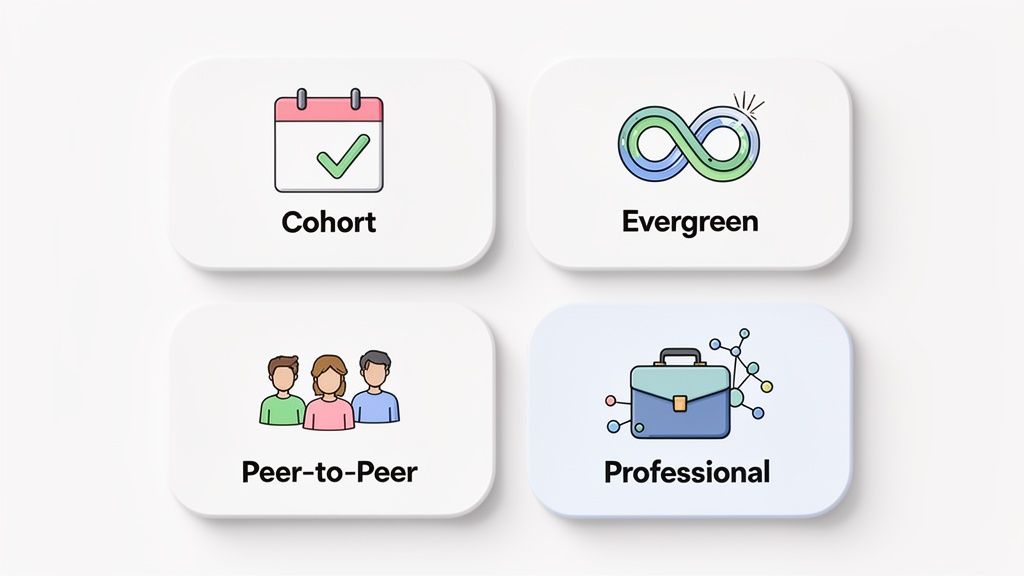
Not all learning communities are the same. The model you choose impacts how members interact, what results they get, and how you build a sustainable business. Here are four effective models.
Cohort-Based Communities
Think of this as a digital boot camp. A specific group of people starts and finishes a structured program together over a fixed timeline, like 6 or 12 weeks. This shared schedule creates intense energy, accountability, and camaraderie.
- Best For: High-touch, transformative programs with a clear outcome, like a business accelerator or coding boot camp.
- Engagement Strategy: Urgency is key. Live sessions, group projects, and deadlines keep everyone moving forward together.
- Monetization: Typically a one-time, high-ticket fee for a spot in the cohort. For more on this, see our guide to cohort-based courses.
Evergreen and Peer-to-Peer Groups
Unlike a cohort, an evergreen community is an ongoing membership without a set start or end date. It’s ideal for topics requiring continuous learning, like a membership for freelance writers to share client tips and job leads. This model relies on a steady flow of fresh content and member-led conversations to retain subscribers.
The success of an evergreen community hangs on its ability to become a member's go-to resource. The value isn’t a one-and-done transformation; it's the consistent, reliable support and connection that makes the recurring fee feel like a steal.
A peer-to-peer group is often less formal and more focused on mutual accountability. Imagine a small study group where members push each other to stay on track. They can be monetized but often form organically within larger communities.
Professional Learning Communities
Professional Learning Communities (PLCs) are common in corporate and educational settings. These groups bring together professionals—like teachers from the same district or developers from the same company—to improve their skills and solve job-related challenges.
The focus is on professional development that directly impacts job performance. For instance, schools using PLCs have boosted student reading and math proficiency by 15-25%. The goal is to use collective wisdom to drive better professional outcomes.
Why Learning Communities are a Win-Win
Why should you build or join a learning community? Because they create a powerful win-win scenario. Learners get the support they need to achieve their goals, and creators build a more sustainable and impactful business.
Key Benefits for Learners
Joining a learning community is an investment in a support system, accountability, and a network of peers who understand your journey.
Here's what that means in practice:
- You Finish What You Start: Social accountability keeps you motivated. When others are expecting to see you at the next call or checking on your progress, you're far more likely to stick with it.
- The Learning Is Deeper: Explaining a concept to a peer or articulating a question forces you to engage with the material more deeply than just watching a video. This is where real understanding happens.
- You Build a Real Network: You connect with people on the same path, facing similar challenges. These relationships can lead to collaborations, job opportunities, or even friendships.
The real value isn't just in what the creator teaches, but in the collective wisdom of the community itself. A member’s question answered by a peer is often more relatable and impactful than a top-down explanation.
Strategic Advantages for Creators
For creators, a community is a smart business move that shifts the focus from one-off sales to a stable, long-term asset.
This strategic pivot offers clear advantages:
- Predictable, Recurring Revenue: A membership community provides a steady income stream, replacing the stress of constant product launches. This stability makes it easier to plan and reinvest in your business.
- Self-Sustaining Marketing: A thriving community becomes your best marketing tool. When members get great results, they share their success. Their testimonials and word-of-mouth referrals are more effective than paid ads.
- A Direct Feedback Loop: Your community is the ultimate focus group. You get instant, honest feedback on what's working and what your audience wants next, removing the guesswork from new product creation.
For example, if you're thinking about a podcast, your community can give you immediate feedback on topics and even share their own experience on how to monetize a podcast.
How to Launch Your First Learning Community: A 5-Step Guide
Building your first learning community can be broken down into a practical, five-step roadmap. This guide moves you from an idea to a paid community that delivers real value.
Step 1: Define the Transformation
Before creating content, answer this: What specific result are you promising? People join communities for a transformation, not just information.
Get specific. Are you helping members land their first web development job? Launch a successful Etsy shop? Master meal prepping? Your entire community must be built around this single, compelling goal.
Step 2: Structure Your Content
Once you know the destination, map out the journey. Your content should be a structured learning path that guides members step-by-step. Avoid a random collection of videos and posts.
Break your material into digestible modules or weekly themes. A clear structure provides a sense of progress and prevents overwhelm. For a deeper look, our guide on designing learning experiences offers useful frameworks.
Step 3: Choose Your Technology
Your community needs a home. While free platforms like Facebook Groups or Discord are tempting, they often become disorganized. An all-in-one platform is usually a better choice because it keeps your content, events, and discussions in one focused space.
Look for a platform that lets you:
- Host structured courses with video, text, and quizzes.
- Organize discussions into specific channels.
- Schedule and run live events with automated reminders.
- Process payments for memberships or courses.
Choosing the right technology from the start will save you significant headaches later.
Step 4: Design Your Engagement Rituals
A community needs active nurturing. The best way to do this is with simple, consistent engagement rituals that members can anticipate.
Keep it simple:
- Weekly Wins: A dedicated thread each Friday for members to share their progress.
- Monthly Q&A Calls: A live session for members to get direct feedback from you.
- Daily Prompts: A simple question each morning to spark conversation.
These rituals build habits and make it easy for people to participate.
A successful community is built on rhythm and routine. When members know what to expect and when, they are far more likely to show up and participate, turning passive lurkers into active contributors.
Step 5: Set Up Your Monetization
Finally, decide how you'll get paid. Common models include a monthly or annual subscription, a one-time fee for lifetime access, or a tiered system with different access levels.
Start with a straightforward model. A great approach is to launch with a small "beta" group at a discounted price. This lets you test your content, gather feedback, and collect testimonials before a wider launch. As you grow, explore strategies for growing a loyal audience through community building to attract the right members.
Learning Community Launch Checklist
Use this checklist to stay on track during your launch.
| Phase | Key Action | Kampunity Feature to Use |
|---|---|---|
| 1. Foundation | Define the member transformation and ideal member profile. | N/A - Strategic Planning |
| 2. Content | Outline your core curriculum and create initial modules. | Courses & Resources |
| 3. Technology | Set up your community space, channels, and branding. | Platform Setup & Branding |
| 4. Engagement | Plan your first month of engagement rituals (e.g., weekly Q&A). | Events & Posts |
| 5. Monetization | Connect your Stripe account and create your membership plans. | Payments & Plans |
| 6. Launch | Invite your first "beta" members and gather feedback. | Member Directory & Messaging |
Following these steps will give you a solid foundation for a successful and sustainable community.
How to Measure Community Health
To build a lasting learning community, you must track what matters. Total member count is a vanity metric; it doesn't tell you if people are getting value. Instead, focus on data that shows how deeply members are connecting and how healthy your business is.
It's helpful to split metrics into two categories: Engagement Health and Business Health. This gives you a clear dashboard to make decisions based on behavior, not guesswork.
Measuring Engagement Health
Engagement metrics are your community's pulse. They show whether you've built a vibrant hub or a ghost town.
Track these key numbers:
- Member Contribution Rate: What percentage of members post or comment each month? A healthy community has a broad base of contributors, not just a few loud voices.
- Lurker-to-Participant Ratio: Compare the number of members who only read content (lurkers) to those who actively participate. A high ratio might mean new members feel intimidated or lack a clear way to join conversations.
- Average Response Time: How long does it take for a member's question to get an answer? Quick replies signal that the community is active and helpful.
Many creators celebrate the total number of posts. A more telling metric is the percentage of unique contributors. If only 5% of your members create 90% of the content, you don’t really have a community—you have a handful of superfans and a quiet audience.
Measuring Business Health
Engagement shows your community is active, but business metrics prove it's sustainable. These numbers connect member activity to your bottom line.
Track these financial indicators:
- Member Churn Rate: The percentage of members who cancel their subscription each month. High churn is a red flag that there's a mismatch between the value you promised and what members are experiencing.
- Customer Lifetime Value (LTV): The total revenue you can expect from a single member over their entire time in your community. A rising LTV means you are getting better at retaining members.
- Conversion Rate: What percentage of your free audience (e.g., email subscribers) become paying members? This shows how effectively you are communicating the value of joining.
Frequently Asked Questions
Here are answers to the three most common questions about starting a learning community.
How Much Time Does It Take to Manage?
Managing a community doesn't have to be a 24/7 job. For a group of around 100 members, expect to spend 4-6 hours per week on essential tasks like guiding conversations, hosting a live session, and preparing content.
A typical week might look like this:
- Content Prep (1-2 hours): Drafting a weekly prompt, recording a short video, or sharing a resource.
- Community Engagement (2-3 hours): Responding in threads, welcoming new members, and sparking conversation.
- Live Events (1 hour): Hosting a weekly Q&A or a bi-weekly workshop.
Actionable Tip: Use scheduling tools to pre-load posts and create templates for your events. This cuts down on prep time and lets you focus on interacting with members.
Can I Start Without a Big Audience?
Yes. In fact, starting small is an advantage. You don't need a huge email list. All you need is a core group of 10-20 founding members who are excited about the transformation you offer.
Launching with a small, dedicated group lets you deliver an incredible, high-touch experience. These founding members will give you priceless feedback and become your most passionate advocates, fueling organic growth through powerful word-of-mouth.
Actionable Tip: Reach out to your most engaged email subscribers or social media followers and offer them a special "founding member" discount. This validates your idea and helps you build a strong foundation before scaling.
How Is This Different From a Facebook Group?
A dedicated learning community and a Facebook Group are fundamentally different in purpose and structure.
A learning community is designed around a specific goal, with a clear learning path. It's a focused environment built for progress, free from the distractions of a social media feed. A dedicated platform keeps your courses, events, and discussions organized in one place, creating a more valuable experience for your paying members.
Ready to build a learning community that delivers real results? Kampunity gives you all the tools you need—courses, events, chat, and payments—in one simple, powerful platform. Turn your expertise into a thriving business. Start building your community with Kampunity today.