

A Practical Guide to Creating Cohort Based Courses


Table of Contents
- What Are Cohort Based Courses And Why Do They Work?
- How to Design an Experience That Actually Changes People
- The Operational Backbone For A Seamless Course
- Key Metrics For Measuring Course Success
- Pricing And Monetization Strategies That Work
- Your Go-Live Launch Checklist
- Frequently Asked Questions About Cohort-Based Courses
Cohort-based courses are simple: a group of students, or a "cohort," goes through a course together on a set schedule. Unlike a self-paced course where you learn alone, a cohort-based course (CBC) blends live, interactive sessions with community collaboration. This structure creates accountability and engagement, which is why students are far more likely to complete them.
What Are Cohort Based Courses And Why Do They Work?
A self-paced online course is like buying a workout plan. You have the instructions, but you’re on your own at the gym. It's easy to lose motivation and stop showing up.
A cohort-based course is like joining a group fitness class. You have a coach and teammates who expect to see you every week. That shared experience and accountability push everyone to stick with it and see real results.
This group dynamic is the key. Instead of feeling isolated, students become part of an active community. This builds a powerful sense of accountability. When you know your peers are waiting for your feedback on a project or expecting you in a live workshop, you’re much more likely to stay engaged.
The Core Components of a CBC
Every successful cohort-based course is built on three pillars. The combination of these elements creates a powerful learning environment.
- Fixed Schedule: Everyone starts and finishes on the same dates. This creates a shared timeline and builds momentum, cutting through the procrastination that plagues many self-paced courses.
- Live Interaction: This isn't just watching pre-recorded videos. A great CBC is built around live Q&As, hands-on workshops, and group discussions where students talk directly with instructors and each other.
- Community Focus: The cohort itself is a huge part of the value. Students work on projects together, form study groups, and build professional connections in dedicated spaces like Slack or Discord.
The magic of cohort-based courses is social learning. The collective energy of a group moving forward together is what keeps everyone committed and on track.
A Proven Model for Engagement
The shift to this model is a direct response to the failures of older online learning formats. People quickly realized that watching pre-recorded videos alone wasn't effective. Cohort-based courses make online education feel human again.
The results are clear. While many self-paced online courses have dropout rates as high as 90%, cohort-based courses often see completion rates of 90% or more. Peer interaction doesn't just boost motivation—it helps with information retention. Many top learning platforms now favor this format. You can explore some of the best platforms for cohort-based learning to see how they support this structure.
This approach is a win-win. Students gain practical skills and a professional network, while instructors get instant feedback to improve the course with every cohort.
How to Design an Experience That Actually Changes People
Creating a successful cohort-based course is about engineering a transformation, not just delivering information. A powerful learning experience is the result of intentional design that builds momentum, sparks connection, and pushes students to apply what they’ve learned. The goal is to move them from passive consumption to active creation.
The first week sets the tone. Instead of diving into dense material, use this time to build community and establish clear expectations. A solid onboarding week gets students invested and excited for the journey.
This flow is at the heart of any great cohort course. It moves from a clear schedule to interactive live sessions and into ongoing collaboration.
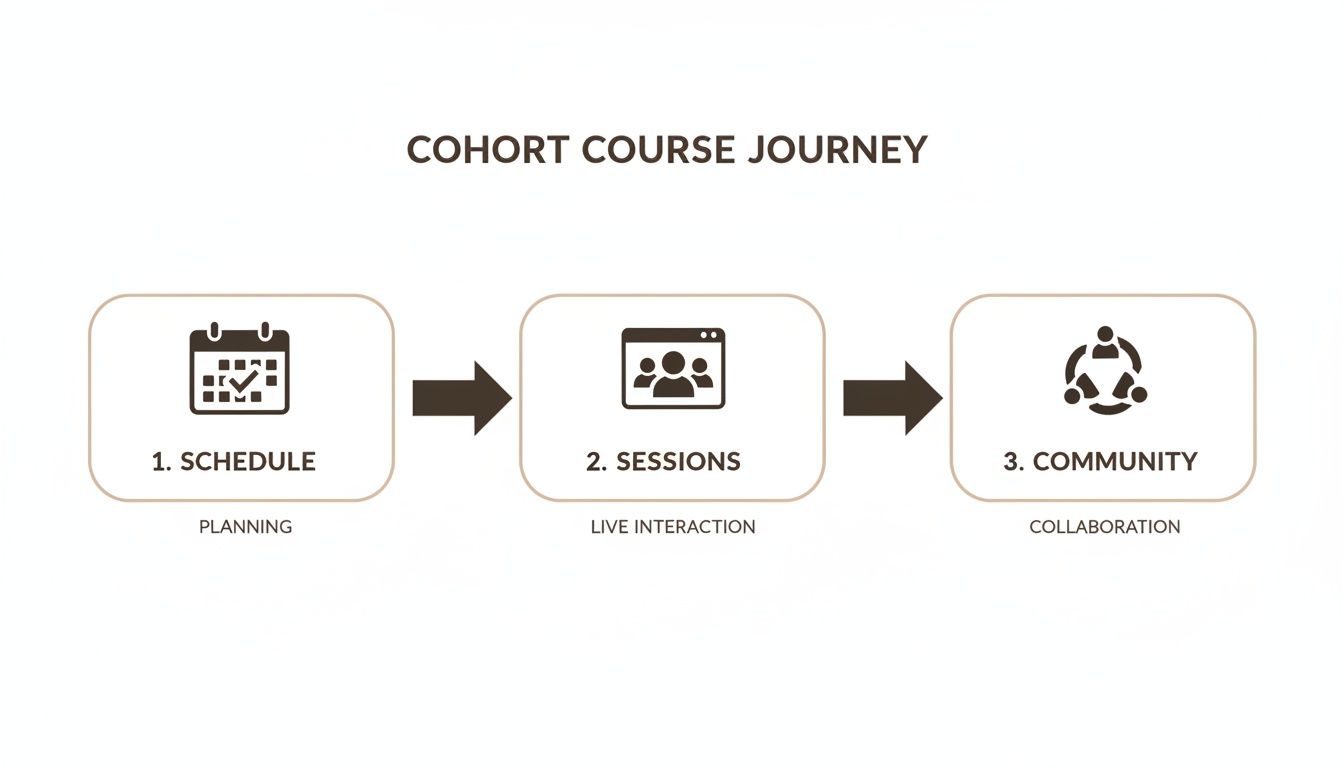
The schedule, live interactions, and peer community are not separate elements; they are interconnected parts of a single, fluid experience.
Crafting a Curriculum That Builds Momentum
A great curriculum tells a story. Start with foundational concepts to build confidence, then gradually introduce more complex challenges. The structure should feel like a steady climb, where each week's material builds directly on the last. This progression keeps people engaged and prevents them from feeling overwhelmed.
Every cohort-based course should lead to a meaningful final project. A capstone project isn't just an exam; it's where students apply everything they've learned. It gives them a tangible outcome for their portfolio, making the value of your course clear.
- For a sales course: The capstone could be a live, simulated client pitch delivered to peers for real-time feedback.
- For a coding bootcamp: Students could team up to solve a tricky, real-world coding problem.
- For a writing workshop: The final project might be submitting a polished short story for peer review and feedback on publishing.
This approach ensures students don't just learn the theory—they prove they can apply it.
Blending Self-Paced Work with Live Interaction
The best cohort-based courses balance self-paced work (asynchronous) with live group sessions (synchronous). This hybrid model respects busy schedules while creating high-impact moments of connection.
Asynchronous content is ideal for delivering core information that students can absorb on their own time. This typically includes:
- Pre-recorded video lectures
- Reading materials and case studies
- Self-guided exercises and quizzes
Synchronous sessions are where the magic happens. These are not lectures. They are interactive, hands-on experiences designed to get everyone participating, providing the energy that self-paced courses lack.
The real value of a cohort-based course is unlocked during live sessions. This is where students get unstuck, build relationships, and connect directly with the material through shared experience.
Designing High-Impact Live Sessions
Your live sessions are the pillars of the course. Each one needs a clear purpose and an engaging format. Avoid repeating information from pre-recorded content. Instead, use this time for activities that are only possible when everyone is together.
Here are four proven formats for high-impact synchronous sessions:
- Expert Q&As: Bring in industry experts or dedicate the time to an "ask me anything" session with you. This provides immense personalized value.
- Hands-On Workshops: Guide students through a practical task in real time, like setting up a marketing campaign or workshopping a piece of writing together.
- Peer Review Circles: Break students into small groups to share their work and give constructive feedback. This builds community and helps everyone learn from different perspectives.
- Group Problem-Solving: Present a real-world challenge and have the cohort work as a team to solve it, simulating a professional environment and reinforcing collaboration.
The Operational Backbone For A Seamless Course
An amazing student experience is built on flawless behind-the-scenes work. While a killer curriculum is essential, it's the operational workflow that makes a cohort-based course feel professional and organized. This system ensures every student feels supported from enrollment to graduation.
Think of it like running a high-end restaurant. The chefs (your curriculum) can create incredible dishes, but without the front-of-house staff (your operations) managing reservations and coordinating service, the experience would fall apart. Your operational plan is the maître d' of your course, guiding everyone smoothly.

Platforms like Maven are designed to manage the complexity of running cohorts, demonstrating the power of a unified dashboard for handling everything from enrollment to community management. The goal is an integrated system to view your schedule, track progress, and manage communications in one place.
The Three Stages Of Course Operations
A smooth operational flow can be broken down into three distinct phases. Each stage has a critical to-do list that prevents last-minute scrambles and ensures a seamless experience.
- Pre-Launch: Prepare your systems and enrollment process before the first student signs up.
- In-Flight: Once the course starts, your focus shifts to active management: facilitating communication, building community, and troubleshooting issues.
- Post-Course: After the last session, gather feedback, celebrate wins, and nurture an ongoing alumni network.
This structured approach transforms your course into a cohesive, well-oiled program.
Your Operational Checklist
Here is a practical checklist of essential tasks for each stage.
Pre-Launch Tasks
- Set Up Enrollment: Configure your payment gateway and build a clear, user-friendly registration page.
- Onboard Students: Create a welcome email sequence with login details, the course schedule, and instructions for joining your community platform.
- Tech Check: Test all your tools—video conferencing, chat platforms, and course hosting—to ensure they work together smoothly.
In-Flight Tasks
- Send Weekly Communications: Post a weekly agenda in the community with session links, pre-work, and key objectives.
- Moderate the Community: Actively participate in your Slack or Discord channels. Answer questions, spark discussions, and maintain energy. Our guide on community management for social media offers relevant tips.
- Monitor Student Progress: Track assignment submissions and participation to identify students who may need extra support.
Post-Course Tasks
- Gather Feedback: Send out a detailed survey to collect testimonials and identify areas for improvement.
- Host a Wrap-Up Event: Organize a virtual graduation or final showcase to celebrate student accomplishments.
- Build the Alumni Network: Create a dedicated space for graduates to stay in touch, share opportunities, and continue learning.
Choosing Your Technology Stack
Your tech stack is the engine of your operations. The goal is to choose tools that integrate seamlessly, creating a frictionless experience for you and your students.
A great tech stack should feel invisible to the student. It works so well that all they have to focus on is learning and connecting with their peers.
Instead of patching together a dozen apps, look for platforms that integrate key functions. Platforms like Kajabi combine course hosting with email marketing. Dedicated CBC platforms like Maven handle enrollment, scheduling, and community in one place. For pure community, Slack and Discord are top choices for their real-time chat and organization features.
Students are willing to pay for premium, interactive experiences. Programs from On Deck, priced from $2,990 to $10,000, confirm that learners will invest heavily when they see the value in structured group learning.
Key Metrics For Measuring Course Success
How do you know if your cohort-based course is working? Forget vanity metrics like social media likes. To understand your course's impact, you need to measure what matters: Are students learning? Are they connecting? Are they getting the value you promised?
Tracking the right numbers gives you a clear picture of your course's health. It helps you pinpoint problems, make data-driven improvements, and prove the value you're delivering. Think of these metrics as your course's vital signs.

Success is a blend of learning outcomes, community health, and business viability. By monitoring these three areas, you get a balanced view of your performance.
Gauging Learning Outcomes
The most important question is: Are students achieving the transformation you promised? This is where you measure their progress and skill development.
Completion Rate: This is the bedrock metric. For cohort-based courses, completion rates can reach 90% (compared to 5-15% for many self-paced options). This number directly reflects student engagement and value. Track how many enrolled students finish the entire course.
Project Submission Rate: If your course has a capstone project, this metric is often more insightful than completion. It shows how many students could successfully apply what they learned. A high submission rate is a powerful signal of an effective curriculum.
Monitoring Community Health
The "cohort" is the heart of a CBC, making community health a direct indicator of success. An active community shows that students are engaged beyond the curriculum.
A silent community is a major red flag. When students are actively asking questions, helping each other, and showing up for live events, you know they're invested.
Here are a few ways to measure community health:
Live Session Attendance: Track the percentage of students who join your live workshops and Q&As. Consistent attendance above 70-80% shows that students find these real-time interactions valuable.
Forum/Community Activity: Measure the pulse of your community platform by tracking the number of posts, comments, and direct messages. This is where you see peer-to-peer learning happen.
Assessing Business Viability
Your course needs to be sustainable. Business metrics help you understand if your model is financially healthy and creating happy customers who will become advocates.
Here’s a breakdown of the most essential KPIs to track for any cohort-based course.
Essential KPIs for Cohort Based Courses
| KPI | What It Measures | How to Track It | Target Benchmark |
|---|---|---|---|
| Completion Rate | The percentage of students who finish the entire course. | (Total Finishers / Total Enrollees) * 100 | > 85% |
| Net Promoter Score (NPS) | Student satisfaction and likelihood to recommend the course. | Post-course survey asking, "How likely are you to recommend this?" | > 50 |
| Live Session Attendance | Engagement with synchronous, real-time learning events. | (Attendees / Total Enrollees) per session | > 75% |
| Project Submission Rate | The ability of students to apply learned concepts practically. | (Projects Submitted / Total Enrollees) * 100 | > 80% |
| Community Engagement | The level of peer-to-peer interaction and participation. | Track posts, comments, and replies in your community forum. | Weekly growth in activity |
| Customer Acquisition Cost (CAC) | The cost to acquire one new student. | Total Marketing Spend / Number of New Students | < 1/3 of LTV |
| Lifetime Value (LTV) | Total revenue a single student generates over time. | Average Course Price * Number of Courses per Student | > 3x CAC |
One of the most powerful metrics is the Net Promoter Score (NPS). After the course, ask students: "On a scale of 0-10, how likely are you to recommend this course to a friend or colleague?" This simple survey is a goldmine for measuring student satisfaction.
Your NPS score groups respondents into Promoters (9-10), Passives (7-8), and Detractors (0-6). A positive score means you have more champions than critics, which fuels word-of-mouth referrals and sustainable growth.
Pricing And Monetization Strategies That Work
Pricing your cohort-based course is a crucial step. You're not just selling information; you're selling a transformation, accountability, a network, and direct access to you. Unlike self-paced courses priced like digital products, a CBC's price tag must reflect its high-touch, high-impact reality. The goal is to build a sustainable model that captures the full value you're creating.
Tiered Pricing Models
One of the most effective strategies is tiered pricing. This gives students choices that align with their budget and desired level of access.
Here’s a simple three-tier structure:
- Standard Tier: This is your core offering. It should include all curriculum, live sessions, and community access—everything needed for the promised transformation.
- Premium Tier: This is the "white-glove" option. It includes everything from the Standard tier, plus high-value extras like 1-on-1 coaching calls, detailed project feedback, or a private Q&A with a guest expert.
- Self-Paced Tier: After a live cohort ends, package the recordings and materials into a lower-priced, evergreen product. This serves people who couldn't join the live schedule or afford the higher price.
For a great example of this approach, look at how Reforge structures their offerings.
They built a powerful membership model around their programs, bundling a deep content library with a high-value peer network. This combination justifies their premium price and shows how compelling a subscription can be when it blends content, community, and live events.
Expanding Your Revenue Streams
Your monetization strategy shouldn't stop at enrollment fees. The most durable course businesses build multiple revenue streams around their core offering.
The most successful cohort-based courses think beyond the initial sale. They build ecosystems where alumni can continue to learn and connect, creating ongoing revenue opportunities.
Consider adding these options to your strategy:
- Corporate Packages: Companies have training budgets. Create a special package for businesses enrolling a group of employees. Offer a bulk rate and add a custom workshop or private Q&A for their team.
- Alumni Community Subscriptions: An alumni community is a fantastic way to maintain momentum. By creating a paid group, you can offer advanced content, exclusive events, and continued networking, all while generating recurring revenue. You'll need the right tools; check out our guide on finding educational community platforms to get started.
- Partnerships and Sponsorships: Partner with companies whose tools your students use. You could host a sponsored session, set up an affiliate deal for recommended products, or co-brand an entire cohort.
Top-tier programs generate serious revenue because they deliver serious value. Platforms like On Deck have priced their programs from $5,000 to $10,000 per cohort, with some annual memberships adding nearly $3,000. These figures show that when the value is clear, people are willing to invest in a transformative learning experience. You can learn more about the booming cohort learning market and see how others are pricing premium programs.
Your Go-Live Launch Checklist
You’ve designed your course and defined the strategy. Now it's time for a smooth launch. The final push can feel chaotic, but a solid checklist turns a mountain of tasks into a manageable path.
This step-by-step process is your pre-flight check to ensure every system is ready before you welcome your first cohort.
Phase 1: Design and Content Finalization
This is where you lock everything down and polish all student-facing materials.
- Finalize Your Curriculum: Review lesson plans, project briefs, and live session agendas to ensure a logical flow from week to week.
- Create All Course Materials: Record and edit pre-recorded videos, design worksheets or templates, and compile reading lists.
- Prepare Your Capstone Project Brief: Write a clear document for the final project that covers goals, requirements, and submission instructions.
Phase 2: Tech and Operations Setup
Next, set up the technical backbone of your course. A clunky user experience can derail motivation, so test everything thoroughly.
A student should never have to think about the technology. Your platform and tools should feel so intuitive that their only focus is on learning and connecting.
- Configure Your Learning Platform: Build the course structure in your chosen platform. Upload all content and set up automations, like dripping content weekly.
- Integrate Your Tools: Ensure your payment processor, email provider, and community platform are communicating correctly. Run a full test transaction to confirm a seamless enrollment process.
- Establish Community Guidelines: Set clear expectations from day one to create a positive, supportive space. You can find inspiration by looking at well-crafted community guidelines examples to get started.
Phase 3: Marketing and Enrollment
With the course built and the tech ready, it’s time to open the doors. This phase is about getting your ideal students excited and enrolled.
- Build Your Landing Page: Create a compelling sales page that clearly explains the transformation, showcases testimonials, and details the schedule and curriculum.
- Open Enrollment: Announce that registration is open across your email list, social media, and other channels.
- Manage Your Waitlist: Give your waitlist early access as a thank-you. This can create powerful social proof and momentum right from the start.
Phase 4: Pre-Cohort Onboarding
The student experience begins at enrollment. This final phase is about welcoming students and making them feel prepared before the course officially starts. A great onboarding process reduces anxiety and sets a positive tone.
- Send a Welcome Email Series: Once someone signs up, send an email confirming their spot. Follow up with a short series that introduces the tools, points them to the community, and reminds them of the schedule.
- Prepare the Kickoff Call: Plan the agenda for your first live session. This call should focus on introductions, setting expectations, and generating excitement, rather than heavy content.
Frequently Asked Questions About Cohort-Based Courses
As you prepare to launch, you'll likely have some questions. Getting these practical details sorted out is key to a successful launch. Here are answers to the most common questions from creators.
What Is The Ideal Cohort Size?
There is no single magic number. The right size depends on the experience you want to create.
For a high-touch, intimate program with personalized feedback—like a writing workshop or executive coaching group—keep it small. A cohort of 10 to 25 students is often the sweet spot, allowing for individual attention.
If your course is more focused on lectures and peer networking, you can go bigger. A group of 50 to 100 students can still feel connected, especially if you use breakout rooms and dedicated community channels to foster smaller interactions.
Actionable Tip: Start small with your first cohort. It’s easier to manage, allows you to fix issues based on direct feedback, and helps you generate powerful testimonials for your next, bigger launch.
How Much Time Does It Take To Run a CBC?
Running a cohort-based course is a significant time commitment, especially while the cohort is live. Unlike a self-paced course where the work is front-loaded, a CBC requires your active, ongoing presence.
Each week, you'll need to block out time for:
- Live Sessions: Your scheduled teaching time.
- Session Prep: Reviewing materials and planning interactive elements.
- Community Management: Answering questions and sparking conversations.
- Feedback & Grading: Reviewing assignments or projects.
A good rule of thumb is to budget at least double your live session time each week for all behind-the-scenes work. So, if you run a 90-minute live class, plan on spending at least another 90 minutes on prep and community engagement.
How Should I Handle Students Who Fall Behind?
It will happen. Life gets in the way. The key is to be proactive and supportive, not punitive.
First, always record your live sessions and post them within 24 hours. This gives students an easy way to catch up. You can also implement a "buddy system" where students pair up for accountability.
If you notice someone disengaging, reach out. A quick, personal check-in via direct message can make a huge difference. Showing that you care and are flexible reinforces the supportive, human-centered nature of cohort-based courses.
Ready to build and monetize your own learning community? Kampunity provides all the tools you need—courses, community, events, and payments—in one seamless platform. Start building your paid community today.