

What Is Gamification in Education? A Practical Guide

Table of Contents
- Why It’s Gaining Momentum
- Gamification at a Glance
- The Psychology Behind Why Gamification Motivates Learners
- Core Gamification Elements You Can Use in Your Course
- Real-World Examples of Gamification in Learning
- How to Build a Gamified Learning Experience, Step by Step
- Common Gamification Mistakes and How to Avoid Them
- Frequently Asked Questions About Gamification in Education
Ever notice how easy it is to spend hours on a game, but a struggle to focus on a 30-minute lecture? Gamification in education uses the engaging elements from games—like points, badges, and competition—and applies them to learning.
This isn't about turning your course into a video game. It’s a strategic layer that reframes learning to tap into our natural drives for achievement, progress, and friendly rivalry. The goal is to transform passive learning into a personal quest.
When a student earns experience points (XP) for finishing a module or unlocks a new badge for mastering a tough concept, they get immediate validation. This instant feedback makes learning feel less like a chore and more like an adventure where every step forward is recognized.
Why It’s Gaining Momentum
The move toward interactive learning isn't just a trend; it's a significant market shift. The global gamification in education market was valued at USD 1.2 billion in 2023 and is projected to reach USD 5.8 billion by 2032. This growth is a direct response to the challenge of keeping modern learners engaged. You can read the full market analysis on dataintelo.com.
So, what’s the practical difference? Gamification works by focusing on:
- Active Participation: Instead of just absorbing information, learners are doing things—completing tasks, solving problems, and interacting with the content to earn rewards.
- Clear Progress Tracking: A progress bar or a new level gives students a tangible sense of how far they've come and what’s next.
- Intrinsic Motivation: While points and badges are external motivators, they help build an internal sense of accomplishment, fostering a genuine desire to master the material.
Gamification uses game mechanics to make challenging tasks feel more achievable and fun. It's about solving problems by engaging users in non-game contexts.
By adding these elements to a course, you create an environment where students aren't just enrolled—they're invested. Education becomes a journey, and every milestone is a reason to celebrate.
Gamification at a Glance
This table shows the core differences between traditional and gamified learning.
| Core Element | Traditional Approach | Gamified Approach |
|---|---|---|
| Progress | Measured by final grades at the end of a unit. | Measured continuously with XP and levels. |
| Feedback | Delayed until a test or assignment is graded. | Immediate feedback through points and badges. |
| Motivation | Relies on long-term goals like a final grade. | Driven by short-term rewards and milestones. |
| Structure | Linear path through static modules. | A journey with unlockable "quests" or levels. |
The gamified approach creates a more dynamic and responsive learning environment designed for engagement from the start.
The Psychology Behind Why Gamification Motivates Learners
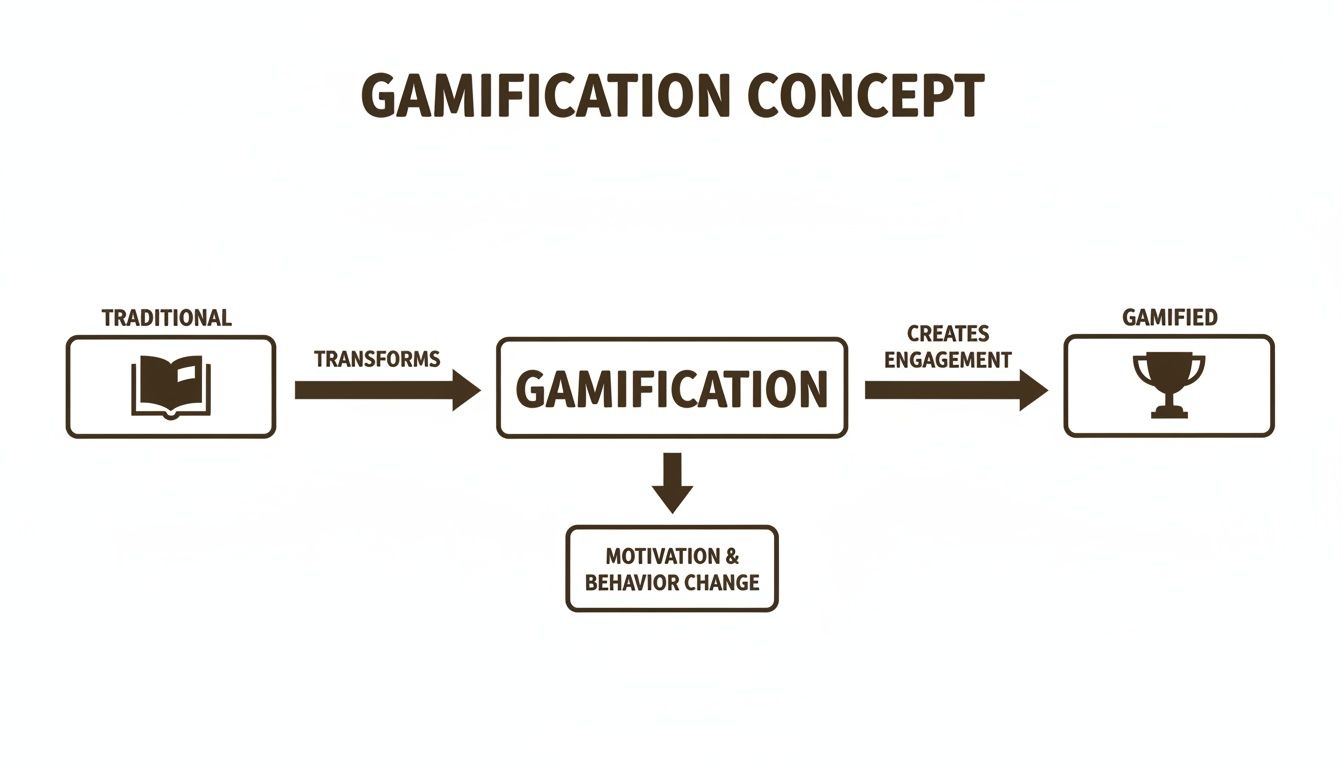
Gamification in education works because it taps directly into how our brains are wired. When a learner earns points or levels up, their brain releases a small amount of dopamine—the "feel-good" chemical. This creates a positive feedback loop that makes them want to repeat the action.
This mechanism turns learning from a distant goal (like passing a final exam) into a series of small, satisfying wins. Instead of waiting weeks for a grade, learners get instant validation that keeps them moving forward.
The core idea is to shift from passive consumption to an active experience where progress is visible and rewarding.
Fulfilling Core Human Needs
Gamification is effective because it fulfills three basic psychological needs outlined in Self-Determination Theory (SDT).
Autonomy (The Need for Control): People want to feel in control of their journey. Gamification provides this by offering choices, such as letting learners tackle branching quests, take on optional challenges, or decide which module to complete next for a reward. This sense of ownership increases engagement.
Competence (The Need for Mastery): We all want to feel capable and skillful. Badges and levels aren't just trinkets; they’re symbols of mastery. They serve as tangible proof of a learner's growing skills, building confidence with every milestone.
Relatedness (The Need to Connect): We are social creatures. Leaderboards, team challenges, and community-wide quests foster a sense of belonging and friendly competition. It makes learners feel part of something bigger than just their own learning path.
When applying these ideas, it's useful to ground them in solid adult learning principles to ensure the experience is both fun and effective.
Effective gamification speaks to these fundamental needs. It gives learners the freedom to choose, the validation that they're improving, and a community to share the journey with.
Balancing Internal and External Motivation
The power of gamification lies in how it blends two types of motivation: extrinsic (external rewards) and intrinsic (internal satisfaction).
Extrinsic motivation comes from outside rewards like points, badges, or a top spot on the leaderboard. These are the hooks that grab a learner’s attention and provide a clear, immediate reason to start a task.
Intrinsic motivation is the internal drive to learn for its own sake—the satisfaction of solving a tough problem or understanding a complex idea.
A well-designed gamified system uses extrinsic rewards to get the ball rolling. As learners collect badges and climb levels, the external validation builds an internal sense of achievement. This is the crucial step for long-term engagement, a topic we explore in our guide on gamification in elearning.
The goal is to use external rewards to spark initial interest, but ultimately to fuel a learner’s own curiosity and desire for mastery.
Core Gamification Elements You Can Use in Your Course
Let's move from theory to practical application. These are the core gamification elements you can use to turn your course into a dynamic learning adventure.
Think of these as your building blocks. You don't need to use all of them at once. The key is to pick the right elements that fit your learning goals and your students.
Points: The Currency of Progress
Points are the most fundamental gamification element. They are a form of currency that rewards action and shows progress in real-time. Every time a student finishes a lesson, passes a quiz, or joins a discussion, they earn points.
This simple mechanic provides immediate feedback, reinforcing positive behaviors. Learners see their effort translate into a tangible score right away, making the process feel more responsive and rewarding.
You can use two main types of points:
- Experience Points (XP): These points accumulate over time and determine a student's level, reflecting their overall journey and commitment.
- Redeemable Points: These points can be "spent" on rewards, like unlocking bonus content, accessing a one-on-one session, or getting a discount on a future course.
Levels: The Milestones of Mastery
If points are individual steps, levels are major milestones. Levels give the learning journey a clear structure, breaking down a large amount of information into manageable stages. As students accumulate XP, they "level up," giving them a strong sense of accomplishment.
This system visualizes growth and provides a clear, motivating goal. Unlocking "Level 2" or becoming a "Content Master" feels more satisfying than watching a progress bar move from 50% to 51%.
Badges: The Symbols of Achievement
Badges are digital trophies. While points and levels track linear progress, badges are perfect for celebrating specific skills and achievements.
A badge's true power lies in recognizing more than just course completion. Use them to highlight specific skills, helpful community interactions, or success in a difficult module.
For example, you could award badges like:
- "Quiz Whiz" for scoring a perfect 100% on a challenging test.
- "Community Helper" for answering five questions from other students in the forum.
- "Fast Starter" for finishing the first module within 24 hours of enrolling.
These recognitions make learners feel valued for their unique contributions. Research shows gamified learning can boost student test scores by up to 34% and increase completion rates by 15%. You can discover the gamification statistics on imaginovation.net to see more of the data.
Leaderboards: The Engine for Friendly Competition
Leaderboards tap into our natural drive for social standing by showing who is at the top based on points or achievements. When used correctly, they can inspire learners to put in extra effort.
However, a single, static leaderboard can be discouraging for new students.
To keep leaderboards motivating and fair:
- Reset them periodically: A weekly or monthly reset gives everyone a fresh start.
- Create team-based competitions: This fosters collaboration and reduces individual pressure.
- Show "local" rankings: Instead of a giant list, show learners where they stand relative to the five people just above and below them. This makes climbing the ranks feel achievable.
Quests: The Framework for Your Story
Quests reframe your curriculum as a compelling adventure. Instead of a dry list of lessons, you can structure modules as "quests" or "missions." This narrative layer gives learning a sense of purpose and makes it more exciting.
For example, a marketing course could have a module called "The Quest for the Perfect Headline," where each lesson is a step toward that goal. Completing that quest might unlock the next chapter, like "The Social Media Gauntlet."
This storytelling approach ties all the other game mechanics together, creating a cohesive experience that keeps students engaged from the beginning.
Real-World Examples of Gamification in Learning
Seeing gamification in action helps make the concepts clear. Let's look at how real platforms use game mechanics to build effective learning experiences.
These examples show how simple ideas like points and badges can produce impressive results.
A well-known example is Duolingo. The language-learning app successfully gets millions of users to practice daily. Its secret is a simple mix of streaks, experience points (XP), and weekly leaderboards.
The "streak" feature tracks consecutive days of practice, forming a powerful habit. The leaderboards add friendly competition, encouraging users to complete one more lesson to outrank a friend. It's a perfect case study of how a few well-chosen mechanics can build incredible consistency.
A Creator’s Case Study in Boosting Course Completion
You don't need a massive app to achieve these results. A creator running a cohort-based programming course faced a common problem: students started with excitement but lost motivation halfway through, leading to low completion rates.
They implemented a straightforward gamification strategy focused on progress and recognition:
- Points for Every Action: Students earned 10 XP for each video lesson finished, 25 XP for passing a quiz, and 5 XP for participating in a community discussion.
- Badges for Big Wins: They created badges to celebrate key milestones. Scoring over 90% on a tough test earned a "Code Commando" badge, while students who consistently helped others received a "Community Catalyst" badge.
- Smarter Leaderboards: Instead of one large leaderboard, they created smaller ones for each cohort, making the competition feel more personal and winnable.
The impact was significant. Within two cohorts, the course completion rate increased by 40%. Students felt more motivated and connected to the material and their classmates.
For more inspiration, you can explore other successful gamification examples from various fields.
Choosing The Right Gamification Strategy For Your Community
There is no one-size-fits-all solution. The right game mechanics depend on your goals. A self-paced course for independent learners requires a different strategy than a collaborative, project-based program.
Match the mechanics to the behaviors you want to encourage. Use the table below as a guide for selecting the most effective approach.
| Community Type | Primary Goal | Recommended Mechanics | Practical Implementation Tip |
|---|---|---|---|
| Self-Paced Course | Encourage consistent progress | XP for lessons, Badges for module completion, and Streaks | Set up automated XP rewards for each video lesson viewed to provide learners with immediate feedback on their progress. |
| Cohort-Based Program | Foster collaboration and peer support | Team-based Leaderboards, Community-help Badges, and Group Quests | Create a "Study Group Challenge" where teams earn points together, and use a private channel for their leaderboard. |
| Membership Community | Drive ongoing engagement | Points for comments and posts, Levels for community status | Award XP for valuable contributions in community channels to recognize and reward your most active members. |
| Certification Program | Motivate skill mastery | Skill-specific Badges, Unlockable expert content, Final Exam Leaderboard | Gate advanced course materials so they only unlock after a member earns a specific achievement badge for a prerequisite skill. |
The best strategy is one that feels authentic to your community and supports your members' goals. Start small, observe what resonates, and adjust as you learn what your audience responds to.
How to Build a Gamified Learning Experience, Step by Step
Implementing gamification doesn't have to be complicated. By following a clear framework, you can integrate game mechanics into your course in a purposeful and effective way.
This five-step playbook breaks down the process to help you focus on boosting student engagement.
Step 1: Define Your Learning Objectives
Before creating points or badges, ask the most important question: What do you want your students to do? Your gamification strategy must be directly linked to your learning goals.
Start by listing the key actions that signal a student is learning effectively. These are the behaviors you want to encourage and reward.
Your list might include:
- Completing every lesson in a difficult module.
- Scoring 90% or higher on a critical quiz.
- Leaving thoughtful feedback on a classmate's project.
- Contributing to weekly discussions with a relevant comment.
These objectives become the blueprint for your reward system, ensuring every point has a purpose. To ensure your goals are effective, rely on proven instructional design best practices.
Step 2: Choose Your Core Mechanics
Now that you know what to encourage, pick the right tools. Instead of using every game mechanic, start small and build up.
Begin with one or two foundational elements:
- Points (XP): This versatile tool provides instant feedback for taking the right actions. Think of it as the currency of progress.
- Badges: Use these to celebrate major milestones and achievements that signify real accomplishment.
Once you master these, you can consider adding levels or leaderboards. Starting simple lets you test what works without overwhelming you or your students.
Step 3: Set Up Your Rewards System
Now, connect your objectives from Step 1 to the mechanics from Step 2. Decide how many points each action is worth. A good system should reward both effort and mastery.
Here’s a sample structure you can adapt:
- Watch a lesson video: 10 XP
- Complete a lesson quiz: 25 XP
- Score 100% on a quiz: 50 XP Bonus
- Post in a discussion forum: 5 XP
- Reply to another student’s comment: 10 XP
Pro Tip: Assign more points to tasks that are more difficult or critical to the learning process. This signals to your students which activities to prioritize.
This structure creates a clear path forward, showing learners exactly how to progress. For more strategies, our guide on designing learning experiences offers additional insights.
Step 4: Design Meaningful Achievements
Badges are only effective if they feel earned. No one gets excited about a badge for simply logging in. Design achievements that give your students a real sense of pride.
Each badge should mark a genuine milestone. For example:
- "Module Master": Awarded for finishing all lessons and quizzes in a section.
- "Top Performer": Given to students who maintain an overall course score above 95%.
- "Community Champion": For students who have helped 10 different peers with their questions.
Give your badges engaging names and create visuals that match your course's tone. A well-designed badge is a powerful symbol of progress.
Step 5: Introduce Leaderboards for a Dose of Motivation
Once your points and badges are working well, a leaderboard can add a fun, competitive element. The key is to implement it thoughtfully. A single, all-time leaderboard can demotivate anyone who doesn't join on day one.
Here’s how to make leaderboards work for everyone:
- Use Weekly or Monthly Resets: This gives everyone a fresh start and a new chance to reach the top.
- Filter by Group or Cohort: For cohort-based courses, create separate leaderboards for each group to make the competition more relevant.
- Show Relative Rankings: Instead of a long list, show a user their position relative to the five people above and below them. This makes moving up feel more attainable.
Following these steps will help you build a gamified system that actively supports learning and helps students achieve their goals.
Common Gamification Mistakes and How to Avoid Them
It's easy to get excited about gamification, but a few common missteps can turn a good idea into a frustrating experience. Getting it right from the start is key to creating a system that motivates learners long-term.
One of the biggest traps is focusing too much on rewards and not enough on learning. When points and badges become the main goal, students may click through content just to earn points without absorbing the material. Rewards should be a byproduct of genuine progress, not the goal itself.
Keep the Learning Front and Center
To avoid this, tie every reward to a meaningful learning outcome. Don't award points for just logging in. Instead, award them when a student demonstrates a new skill, completes a difficult quiz, or shares a valuable insight. This keeps the focus on mastery and personal growth.
A great gamification system makes your students feel smart, capable, and connected. A poorly designed one makes them feel like they're chasing meaningless numbers.
Getting this balance right is crucial. It's why the gamification in education market is projected to grow from US$3.5 billion in 2024 to US$14.3 billion by 2030. The platforms driving this growth are those that successfully blend motivation with educational value. You can find more data on this market growth at marketresearch.com.
Avoiding Common Implementation Pitfalls
Another common mistake is creating competition that feels punishing rather than fun. A single, all-time leaderboard can demotivate new members who see a large gap they can't overcome. On the other hand, a system with too many rules can confuse people before they even start.
Here’s how to build a healthier, more inclusive system:
To fix punishing competition: Avoid a single, static leaderboard. Use weekly or monthly resets so everyone gets a fresh start. You can also create smaller leaderboards for specific groups or cohorts to make the competition more achievable.
To avoid over-complicating things: Start small. You don't need every feature on day one. Begin with one or two core mechanics, like XP for completing lessons and badges for mastering a module. You can add more complexity once your community understands the basics.
By avoiding these common mistakes, you’ll build a system that supports and encourages every student on their learning journey.
Frequently Asked Questions About Gamification in Education
Even with a clear plan, you may have questions about how gamification works in a real course. Here are answers to some of the most common questions from educators.
Is Gamification a Good Fit for Every Subject and Age Group?
Yes, but it must be tailored to the audience. A gamified system for corporate professionals will look different from one for middle schoolers.
Younger students often respond well to vibrant badges, customizable avatars, and story-driven quests. For adult learners, focus on mechanics that reflect professional growth and mastery, such as skill-based achievements, expert certifications, or leaderboards that showcase progress on real-world projects.
How Do I Know If My Gamification Strategy Is Actually Working?
Look at a mix of data and direct feedback. Track metrics that tie directly to your course goals.
- Completion Rates: Are more people finishing the course?
- Engagement Metrics: Are you seeing more comments, quiz attempts, or time spent on lessons?
- Performance Data: Are assignment grades and quiz scores improving?
Don't just rely on numbers. The most valuable insights can come from asking your students. A quick survey about their motivation can provide information that data alone cannot.
Won't Leaderboards Just Discourage Learners at the Bottom?
This is a valid concern. A single, permanent leaderboard will likely demotivate anyone not at the top. Newcomers will see large point gaps and feel discouraged.
The solution is to design leaderboards thoughtfully. Instead of one large ranking, reset it weekly or monthly. This gives everyone a fresh start. You can also create team-based leaderboards that foster collaboration or show a learner their rank relative to the few people directly above and below them, making progress feel more achievable.
Ready to turn your course into an engaging, gamified experience? With Kampunity, you can easily build in XP, badges, and leaderboards to motivate your learners and boost completion rates. Start building your community for free on Kampunity today!