

How to Start an Information Product Business (Step-by-Step Guide)

Table of Contents
An information product business turns your expertise into digital assets you can sell online. Instead of trading time for money, you package your knowledge—whether it's coding, personal finance, or gardening—into products like online courses, ebooks, or workshops.
You create a product once and can sell it repeatedly to a global audience, breaking the direct link between your hours worked and your income earned.
From Expert to Digital Entrepreneur
Let's use a practical example. Imagine you're a personal trainer. Your income is capped by the number of clients you can physically train each day.
Now, what if you created a "12-Week Fitness Transformation" online course? You record the workout videos, write the meal plans, and build the program once. You can then sell that same course to thousands of people. You’ve shifted from a service provider to a digital business owner, scaling your income beyond your personal time.
This isn't a small niche; it's a rapidly growing industry. The market for massive open online courses (MOOCs) was valued at USD 26 billion and is projected to grow at a 39.3% CAGR through 2034. This growth shows a clear demand for structured online learning that integrates courses, community, and live interaction.
The Core Benefits of This Business Model
The appeal of an info-product business goes beyond revenue. It offers a unique combination of freedom, impact, and profitability.
Here’s why many experts are making this shift:
- Low Overhead Costs: There's no rent for a physical location or cost of goods sold. Your main expenses are your hosting platform and marketing, making it an extremely lean business to start.
- High Profit Margins: After the initial creation cost, the cost to sell an additional digital copy is nearly zero. This allows for significantly higher profit margins compared to physical product businesses.
- Work from Anywhere: Your business operates entirely online, giving you the freedom to work from home, a café, or anywhere with an internet connection.
An information product business sells transformation, not files. Customers aren't buying a PDF or a video; they are buying a clear path to a result they want, guided by your expertise.
This model is ideal for coaches, creators, and teachers looking to scale their impact. To explore this further, check out these strategies to monetize your content and build a creator business.
Choosing Your Information Product Model
Selecting the right business structure is a strategic decision that dictates how you deliver content, the level of support you provide, and the price you can charge. It needs to align with your topic, your audience's needs, and the lifestyle you want to create.
Let's break down the three primary models.
Self-Paced Online Courses
A self-paced course is a complete library of your knowledge, structured for independent learning. You create all the videos, worksheets, and tutorials upfront, and students can buy it and progress through the material on their own schedule. This is the classic "create once, sell forever" model.
This format works best for teaching foundational, evergreen skills. For example, a photographer could create a "Photography 101" course. The principles of aperture and shutter speed are timeless, so the course remains valuable for years with minimal updates.
Best For: Experts who want a scalable, low-touch asset that teaches a structured, step-by-step process.
High-Touch Cohort Programs
Cohort programs are intensive, live learning experiences. A group of students (a "cohort") goes through the curriculum together over a set period, such as 6 or 8 weeks. The model is built on live workshops, group projects, and direct access to the instructor.
Imagine a sales coach helping freelancers land their first $10,000 client. This outcome requires personalized feedback and accountability, which a cohort provides. The high-touch environment justifies a premium price because you are engineering a specific, time-bound result. To succeed, it's crucial to understand the mechanics of cohort-based courses.
A self-paced course sells information. A cohort program sells transformation. The value comes from the live interaction, community, and accountability that drive students to achieve tangible results.
Recurring Revenue Memberships
A membership is a private community where members pay a recurring fee (monthly or annually) for ongoing access to content, resources, and community interaction.
This model is perfect for topics that involve continuous learning, like a foreign language. A Spanish teacher could offer a membership with weekly conversation practice, new vocabulary lessons, and a forum for members to connect. The value lies in the ongoing support and steady progress, not a single outcome.
Comparing Information Product Business Models
This table provides a clear comparison to help you decide which model best fits your expertise and your audience's goals.
| Business Model | Best For | Revenue Model | Community Interaction |
|---|---|---|---|
| Self-Paced Course | Evergreen skills and scalable knowledge | One-time purchase | Low to moderate (forums, Q&A) |
| Cohort Program | Deep transformation and accountability | High-ticket, one-time fee | High (live sessions, group work) |
| Membership | Continuous learning and community | Recurring subscription | High (ongoing discussions, events) |
The right choice depends on the outcome you promise. Are you teaching a defined skill, delivering a life-changing result, or providing ongoing guidance? Answering this question is the first step toward building a successful and sustainable business.
Your Roadmap from Idea to Launch
Turning an idea into a profitable information product follows a clear, step-by-step process. This is a no-fluff guide to take you from initial concept to a successful launch.
Think of it as building a house: you validate the location (market research), draw the blueprint (content creation), choose your contractor (platform selection), and finally, host an open house (the launch).
Stage 1: Validate Your Niche and Idea
Before creating any content, you must answer one critical question: Will people pay for this?
Validation is the most important step, yet it's the one most creators skip. It’s not about asking friends if your idea is good; it's about finding concrete evidence that a market is actively seeking a solution to a problem you can solve. This step de-risks your entire project.
Here are three simple, actionable ways to validate your idea:
- Search for Problems: Go to platforms where your target audience gathers, like Reddit, Quora, or niche Facebook Groups. Search for keywords related to your topic and look for questions like "How do I...?" or "I'm struggling with..." A high volume of these questions indicates strong demand for your knowledge.
- Run a Pre-Sale: Create a simple landing page describing your future product's promise and outcome. Drive traffic to it from your social media and offer an "early-bird" discount for people who buy now. Even a handful of pre-sale customers is definitive proof of demand.
- Host a Free Workshop: Offer a free live webinar on a small, specific part of your topic. At the end, pitch your more comprehensive paid program and see how many attendees are interested. This is a direct and powerful way to gauge market appetite.
The model you choose—course, cohort, or membership—will be the structure for delivering your validated idea.
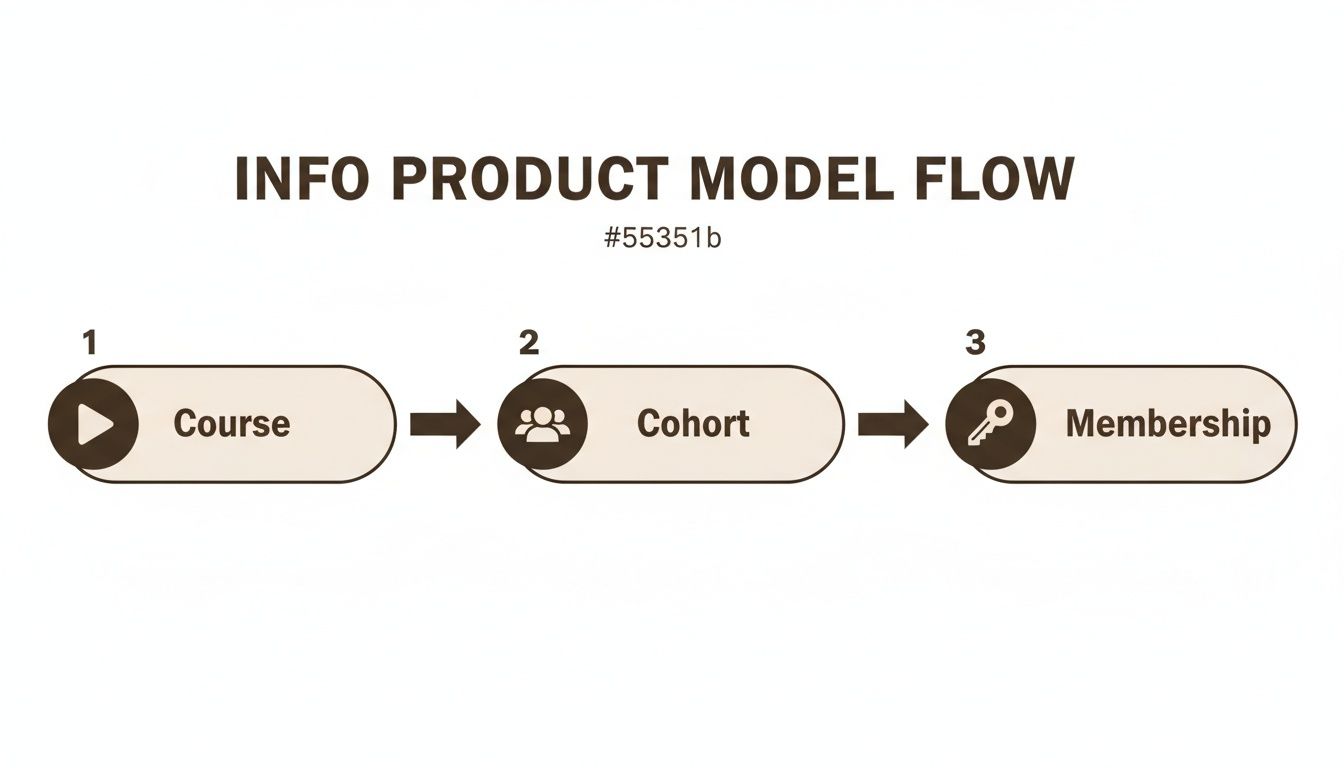
This choice will shape the content you create and the platform you need.
Stage 2: Structure and Create High-Value Content
Once you've confirmed people want your product, it's time to build it. A great information product is not an information dump; it's a structured path to transformation.
People buy results, not content.
Start by creating a detailed outline. Begin with the final outcome your customer wants and work backward. Break the journey into logical modules, then divide each module into individual, actionable lessons.
Don’t try to create a massive, all-encompassing product first. Start with a "Minimum Viable Product" that solves a specific, urgent problem. For a fitness coach, this could be a "Lose Your First 10 Pounds" program instead of a "Total Life Overhaul." It's easier to create, easier to sell, and delivers a quick win for your customers.
When creating content, prioritize clarity. Use short videos, downloadable worksheets, and clear action steps. Every piece of content should move your student one step closer to their goal.
Stage 3: Select the Right Platform to Host Your Product
Your platform is the foundation of your online business. The right choice simplifies your operations, while the wrong one creates technical headaches and frustrates customers.
Look for an all-in-one platform that combines these core functions:
- Course Hosting: An intuitive builder to upload videos, create lessons, and attach resources.
- Community Hub: A dedicated space with chat channels or forums for student interaction.
- Event Management: Tools to schedule and run live workshops, Q&A sessions, or coaching calls.
- Payment Processing: Secure, integrated payments for both one-time purchases and recurring subscriptions.
Platforms like Kampunity are designed specifically for this, integrating these features into one seamless system. This avoids the complexity of piecing together multiple tools. Our guide on the best platforms to sell digital products can help you compare your options.
Stage 4: Execute a Launch That Builds Momentum
A launch is a planned event designed to build excitement and drive sales over a short period. A successful launch can generate more revenue in one week than months of passive selling.
A standard launch follows four phases:
- The Pre-Launch (1-2 weeks prior): Warm up your audience by sharing valuable free content related to your product's topic. Hint that something new is coming and build an email waitlist for exclusive updates.
- The Launch Trigger: Start your launch with a high-value event, like a live webinar or a multi-day challenge. Deliver genuine value for free, then transition into your paid product as the logical next step.
- The Open Cart (5-7 days): This is the period when your product is available for purchase. Use daily emails and social media posts to address objections, share testimonials, and highlight the transformation. Use clear deadlines or limited-time bonuses to create urgency.
- The Post-Launch: The moment the cart closes, shift your entire focus to delivering an exceptional experience for your new customers. This turns buyers into advocates who will promote your next launch.
How to Price and Package Your Products
Pricing your knowledge can feel daunting, but it shouldn't be. The goal is to set a price that reflects the value of the transformation you provide, not just the amount of content you've created.
You aren't selling videos or PDFs; you're selling a result. A course on landing a promotion isn't just content—it's a path to a potential $10,000 raise. When you frame your price around that value, the investment becomes a clear and logical choice for the customer.
Adopt Value-Based Pricing
This is the most effective pricing strategy for an information product business. Instead of looking at competitors or calculating your hours, anchor your price to the tangible value your customer receives.
Ask yourself one question: What is this outcome worth to my ideal customer?
- Financial Gain: Does your product help them earn more money or land new clients? Quantify it. For example, "This system helps freelancers land $5,000 projects."
- Time Savings: How many hours will they save each week? Frame it as "reclaim 10 hours a month" to focus on what matters.
- Emotional Benefit: Will it reduce stress, build confidence, or help them achieve a lifelong goal? This emotional payoff is often the most powerful motivator.
When you clearly communicate this return on investment on your sales page, the price becomes an investment, not an expense.
Structure Your Offers with Tiered Packaging
Offering tiered packages allows you to serve a broader audience with different needs and budgets. Instead of a single "take it or leave it" price, you create multiple options.
Think of it like buying a car: there's a standard model, an upgraded version, and a premium package. Each tier adds more value, such as more direct support or personalized guidance.
Tiered packaging uses a psychological principle called price anchoring. A higher-priced premium tier makes your mid-tier offer seem more reasonable and valuable by comparison, positioning it as the "best value" choice.
Here’s a practical example for a business coach:
| Tier | Name | Price | What's Included |
|---|---|---|---|
| Basic | The DIY Toolkit | $297 | All self-paced course videos and downloadable worksheets. |
| Standard | The Community Accelerator | $997 | Everything in Basic, plus access to the private community and weekly live Q&A calls. |
| Premium | The VIP Mentorship | $2,497 | Everything in Standard, plus two private 1-on-1 coaching calls for a custom strategy. |
This structure works because it meets customers where they are. A self-starter can choose the DIY Toolkit, while someone needing more accountability will see the value in the Community Accelerator.
Implement Recurring Revenue Models
For long-term stability, nothing beats recurring revenue. Memberships and subscriptions create predictable monthly income, smoothing out the launch cycle and allowing you to focus on delivering continuous value.
A recurring model is ideal when the customer's journey is ongoing. For example, a fitness expert can offer a membership with new monthly workout plans and nutrition guides. The value is in the continuous support that helps members maintain their results. This fosters a loyal community that becomes the core of your business.
Marketing and Scaling Your Business for Long-Term Growth
Creating a great product is only half the battle. To build a sustainable business, you must shift your focus from creation to connection—getting your product in front of the right people and establishing a foundation for long-term growth.
This means implementing smart marketing strategies and scalable systems. There are many proven strategies for growing your online business that apply directly to information products.
Building Your Audience with Content
Consistently creating valuable content is the most effective marketing engine for an information product business. It builds trust and positions you as the go-to expert in your niche. Your content attracts potential customers who are already searching for the solutions you provide.
- Blog Posts and SEO: Write helpful, search-optimized articles that answer your audience's questions. A financial coach could write an article titled, "5 Simple Steps to Create Your First Budget," attracting people searching for that exact topic on Google.
- Social Media: Be active on the platforms where your ideal customers spend their time. Focus on teaching, not just selling. Share quick tips, insightful posts, and behind-the-scenes content to build a relationship with your followers.
- Email Marketing: Your email list is your most valuable business asset. Offer a free resource, like a checklist or guide, in exchange for an email address. This gives you a direct communication channel with your most engaged followers, independent of social media algorithms.
Scaling Beyond the Sale with Community
The key to long-term growth is turning customers into lifelong fans. An engaged community is your most powerful tool for this.
Community transforms passive learners into active brand advocates. Completion rates for self-paced online courses are often low, around 10-15%. However, adding community features like discussion forums and live events can boost engagement to 70% or higher. This dramatically increases customer retention and lifetime value.
The health of your business is measured by customer lifetime value, not one-time sales. A strong community multiplies this value by creating an environment where people stay, learn, and grow with you.
Integrating Community for Sustainable Growth
A thriving community must be designed intentionally. By integrating features that encourage interaction, you create a powerful word-of-mouth marketing engine.
Here are actionable steps to build your community:
- Host Regular Live Events: Schedule weekly or monthly live Q&As or workshops. This direct access makes members feel valued and keeps them engaged.
- Launch Group Challenges: Create short, focused challenges (e.g., a "5-Day Productivity Sprint") that encourage members to take action together. Shared progress builds camaraderie and delivers tangible results.
- Encourage Peer-to-Peer Support: Set up channels where members can ask questions and help each other. When students start answering one another's questions, you have built a self-sustaining learning community.
These strategies shift your business from a transactional model to a relational one. You are no longer just selling a product; you are building a movement. This is the path to a resilient, profitable, and impactful business.
Common Questions About Information Product Businesses
Starting an information product business can bring up a few common questions. Here are clear, practical answers to help you move forward with confidence.
How Much Does It Cost to Start?
Starting an info product business is highly affordable. Unlike a traditional business, there are no inventory or rent costs. Your primary expenses will be your hosting platform and any marketing tools you choose.
An all-in-one platform can minimize costs by bundling course hosting, community, and payments into a single subscription. Many platforms offer free starter plans where you only pay a transaction fee on sales. Beyond that, a good microphone and a small marketing budget are helpful, but you can get started for under a few hundred dollars.
Do I Need to Be a Tech Expert to Succeed?
Absolutely not. Modern platforms are designed for creators, not developers. The days of needing to hire a web developer or struggle with complex plugins are over.
Successful creators focus on two things: creating great content and connecting with their audience. The right platform handles the technology, allowing you to stay in your zone of genius.
These platforms feature intuitive drag-and-drop builders, simple event scheduling, and easy-to-manage dashboards. The technology is designed to be invisible so your expertise can shine.
How Do I Protect My Content from Being Stolen?
This is a common concern, but there are practical steps to protect your work. While no method is foolproof, the most important protection is using a secure, login-required platform. This single barrier prevents casual piracy.
You can add extra layers of protection:
- Watermarking: Add your logo or name to your videos and PDFs as a visual deterrent.
- Community Gating: Make your most valuable content accessible only to members inside your private community.
However, the best defense is building a brand and community that provides value beyond the content itself. People can copy your videos, but they can't copy the experience of live Q&As, direct access to you, or the network of other members.
How Long Does It Take to Become Profitable?
Profitability depends on your niche, audience size, and marketing efforts. If you already have an engaged audience, you can be profitable from your first launch. If you are starting from scratch, it typically takes 6-12 months to build trust and generate consistent income.
The key is to focus on delivering exceptional value first. Profit is the natural result of serving an audience that trusts you as their go-to expert.
Ready to build a thriving learning community around your expertise without the technical headaches? With Kampunity, you get an all-in-one platform to host your courses, manage events, and build an engaged community that drives recurring revenue. Start building your community for free today!