

What Is a Learning Community and How Do You Build One?

Table of Contents
- What a Learning Community Actually Looks Like
- The Four Pillars of a Thriving Learning Community
- Why Learning Communities Are a Win-Win for Everyone
- Choosing The Right Model For Your Audience
- Your Blueprint for Building a Learning Community
- Common Questions About Learning Communities
A learning community is a group of people who share a common goal to learn a specific skill or topic. More than that, it's an environment where members actively participate, collaborate, and support each other's growth.
Think of it this way: a standard online course is like a lecture hall where you listen to an expert. A learning community is like a workshop where you roll up your sleeves and build skills alongside your peers. The community itself becomes a tool that speeds up learning for everyone involved.
What a Learning Community Actually Looks Like

Imagine the difference between reading a cookbook alone and joining a cooking club. The cookbook gives you the information, but the club provides real-time feedback, shared discoveries, and accountability. You learn faster because you’re doing, sharing, and problem-solving together.
That's the essence of a learning community: an interactive space built on mutual growth.
The concept has deep roots in education. For example, Learning Forward defines professional learning communities as groups of educators who meet regularly to improve their skills and student outcomes. This highlights the model's focus on continuous, collective improvement. You can explore the academic background of this model in resources from EBSCO.
What Makes It Different
A learning community moves beyond passive learning. It turns the solitary act of consuming content into an active, collaborative journey. The value isn't just in the course material; it's in the connections, the group problem-solving, and the shared "aha!" moments.
A true learning community is an ecosystem where learning is co-created, not just consumed. Members are as much a part of the curriculum as the content itself.
To make this clear, let's break down the core components. The table below shows what these attributes look like in practice.
Learning Community at a Glance
| Core Attribute | What It Means in Practice |
|---|---|
| A Shared Purpose | Everyone is united by a clear, common goal, like mastering a new software, learning a language, or launching a freelance business. |
| Active Participation | Engagement is expected. Members contribute through discussions, projects, and peer feedback instead of just watching from the sidelines. |
| Mutual Support | A culture of helping one another exists. Members feel safe asking questions, sharing struggles, and celebrating wins together. |
| Ongoing Interaction | Unlike a course with a hard stop, a learning community fosters long-term relationships and continuous learning that extends beyond the initial content. |
This model shifts the focus from a top-down, expert-to-student dynamic to a network of shared knowledge. Each person’s experience adds value, making the learning process richer and more effective for everyone.
The Four Pillars of a Thriving Learning Community
A successful learning community is built on four interconnected pillars. When these elements work together, they create an environment where people feel motivated, supported, and excited to participate. Understanding these pillars is the first step to building a space that delivers lasting value.
When you get these right, they create a "sense of community." This concept, grounded in research by McMillan and Chavis, is based on the idea that strong communities give people a sense of membership, influence, fulfillment, and a shared emotional connection. This framework has been applied to over 500 educational studies, highlighting its importance. You can discover more about this seminal community framework on ebsco.com.
Here are the four practical pillars you can start building on today.
1. A Powerful Shared Purpose
The most important pillar is a shared purpose. This is your community’s North Star. It’s the unifying reason everyone is there, answering the question: "Why do we exist?"
A weak purpose is generic, like "a place to learn about marketing." A strong, actionable purpose is specific and outcome-focused: "We are a community for freelance writers working to land their first high-paying client."
This clarity acts as a filter, attracting the right people and setting clear expectations from day one.
A shared purpose isn't just a mission statement; it's a rally cry. It transforms a passive audience into an active team working toward a common goal.
2. Intentional Active Participation
Next is active participation. This means designing activities that encourage members to contribute, interact, and take ownership of their learning.
Instead of just consuming information, members become co-creators of the experience. This turns your community from a static library into a dynamic workshop.
Here are three practical ways to encourage participation:
- Weekly Challenges: Post a small, actionable task each week. For example, a photography community could have a weekly "composition challenge" where members share photos based on a specific theme.
- Member-Led Q&As: Empower experienced members to host Q&A sessions on their areas of expertise. This gives them a chance to share their knowledge and builds their authority.
- "Show Your Work" Threads: Create a dedicated space for members to post works-in-progress and get constructive feedback. This fosters a culture of iteration and improvement.
3. Meaningful Collaborative Learning
The third pillar, collaborative learning, is where members learn directly from each other. This shifts the dynamic from a one-to-many model (you to your members) to a many-to-many model.
This peer-to-peer interaction accelerates growth by exposing everyone to diverse perspectives and building deep connections. The community becomes more valuable with every new person who contributes.
Here are a few examples of collaborative learning in action:
- Peer Review Pods: Form small groups of 4-5 members who meet regularly to review each other’s work, whether it’s code, writing, or business plans.
- Group Projects: Kick off a collaborative project where members pool their skills to build something together, like a community-sourced ebook or a small software tool.
- Problem-Solving Sessions: Run live "hot seat" sessions where one member presents a real-world challenge and the group brainstorms solutions together.
4. A Genuinely Supportive Environment
Finally, a supportive environment is the bedrock of psychological safety that allows the other three pillars to exist. When people feel safe, they are more willing to participate, ask "stupid" questions, and share failures without fear of judgment.
Building this atmosphere requires clear community guidelines, proactive moderation, and leading by example. It’s about celebrating effort, not just outcomes, and fostering a culture where vulnerability is a strength. This support system is what keeps members coming back long after they’ve completed the initial content.
Why Learning Communities Are a Win-Win for Everyone
A great learning community provides tangible value to both the members and the creator. For learners, it’s a more effective way to gain skills. For creators, it’s a more sustainable way to build a business.
This mutual exchange transforms the dynamic from a simple transaction into a partnership. Members aren't just customers; they are active participants who help shape their own learning journey.
The Benefits for Members
Joining a learning community offers a richer, more effective way to master a skill. The combination of structured content and peer interaction creates a support system that self-study can't replicate.
Here's what members gain:
- Deeper Learning and Retention: Explaining a concept to someone else is a powerful way to learn. Discussions and group projects force members to move beyond memorization to true understanding.
- Built-in Accountability: It’s easy to quit when no one is watching. A network of peers and mentors provides the motivation to push through difficult learning curves.
- An Expanded Professional Network: Members build real relationships with motivated peers in their field. These connections often lead to friendships, collaborations, and career opportunities.
The biggest advantage for a member is momentum. A well-run learning community provides the structure, support, and peer pressure needed to overcome the frustrating phases where most people give up.
This has a measurable impact. For example, the CDC reports that students who feel connected at school have better academic outcomes. The same principle applies here: a sense of belonging fuels progress. You can explore more on how learning communities change the educational paradigm at gettingsmart.com.
The Advantages for Creators
For creators, a learning community is a strategic asset that builds a resilient, engaged business. It's the difference between the constant hustle of selling one-off courses and building a loyal audience that sticks around.
Creators who use this model see several benefits:
- Higher Member Retention: A course has a start and an end. A community provides ongoing value through new content, events, and connections, leading to higher retention and predictable recurring revenue.
- A Direct Product Feedback Loop: Community discussions are a goldmine of insights. Members will tell you exactly what they're struggling with and what they'd pay to learn next, eliminating guesswork.
- Building a Base of Brand Evangelists: When members achieve their goals, they become your best marketers. Their success stories drive authentic word-of-mouth growth.
Turning Feedback Into Revenue: A Real-World Scenario
Imagine you run a learning community for new podcasters.
In the discussion forums, you notice members constantly ask for advice on affordable audio equipment. They share tips, but it's clear they need a comprehensive guide.
This is direct proof of a common problem.
Now, you can create a paid workshop called "The Budget-Friendly Home Studio." You can pre-sell it to the very members who asked for it, guaranteeing sales before you even create the content. This is how a learning community becomes a responsive business engine.
Choosing The Right Model For Your Audience
Before building, ask yourself: is a learning community the right model for my audience?
Sometimes, a simple online course or a short-term program is a better fit. Understanding the differences between these models is key to building something your audience will actually use and value.
This decision tree can help you determine if a learning community is the right path.
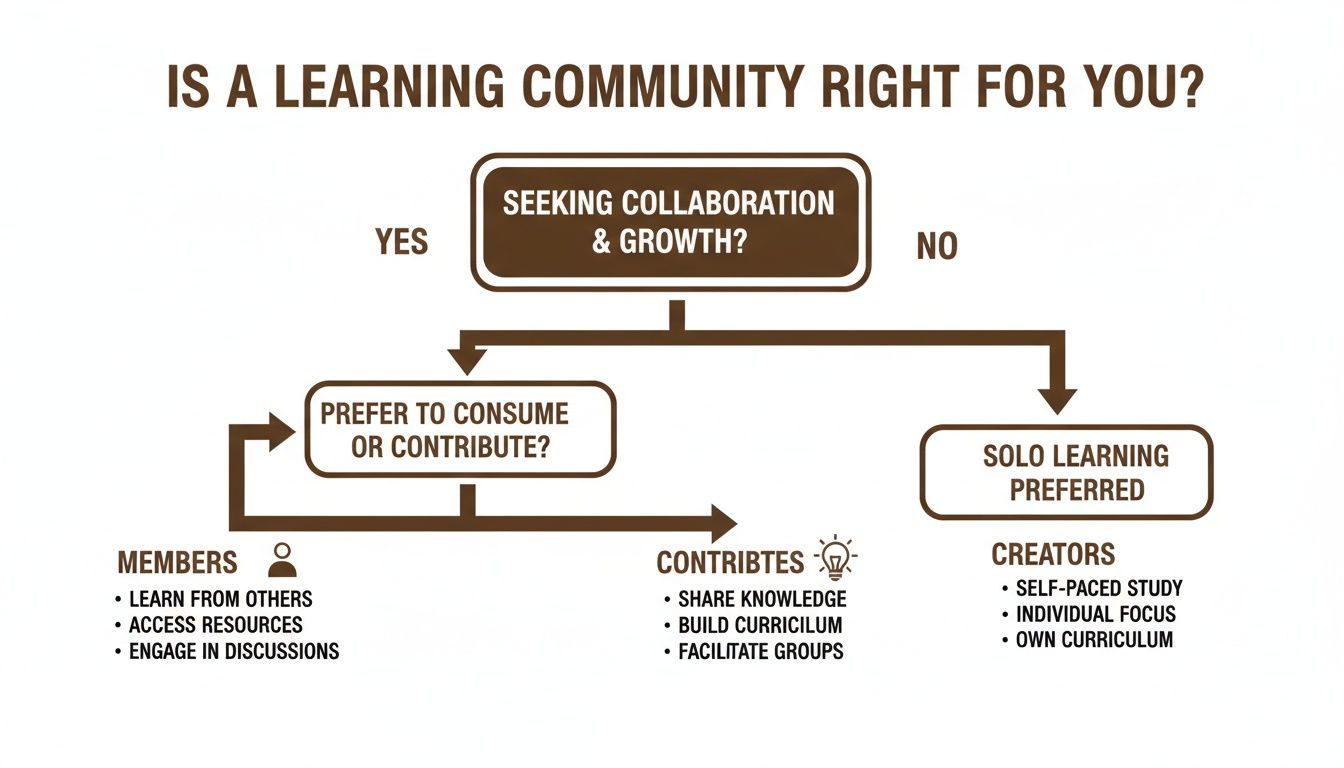
The chart shows that for creators, a community leads to outcomes like recurring revenue and direct audience feedback. For members, the key benefits are accountability and networking—hallmarks of a strong community.
Understanding The Key Differences
Let’s compare the most common online learning formats. The biggest difference is how information flows and how much members interact.
An online course is a one-to-many model. You, the expert, create content, and students consume it on their own. Interaction is minimal. It's best for delivering a structured curriculum efficiently.
A cohort-based course (CBC) adds a social element. A group of students (a cohort) goes through the material together on a fixed schedule. This creates accountability and peer connection, but the experience is time-bound.
A learning community is a many-to-many model. While a creator may provide foundational content, the real value comes from members teaching, debating, and supporting one another. It’s a living ecosystem built for long-term engagement. Explore how these spaces are shaping the future of education.
Here’s a simple analogy: An online course is a book. A cohort-based course is a book club. A learning community is a writer's guild.
A Head-To-Head Comparison
This table breaks down the key differences to help you choose the right framework for your goals and your audience's needs.
Comparison of Learning Models
| Feature | Online Course | Cohort-Based Course | Learning Community |
|---|---|---|---|
| Primary Goal | Knowledge transfer from expert to student. | Guided skill application with peer support. | Continuous growth and collaborative problem-solving. |
| Interaction Model | One-to-many (creator to member). | One-to-many, with some peer-to-peer. | Many-to-many (member-to-member). |
| Pacing | Self-paced, on-demand. | Fixed schedule (e.g., 6 weeks). | Ongoing, with no defined end date. |
| Content Focus | Static, pre-recorded curriculum. | A mix of static content and live events. | Dynamic, with member-generated content and discussions. |
| Typical Duration | Lifetime access, but short-term engagement. | Finite, with a clear start and finish. | Long-term and continuous. |
| Creator Role | Content expert and instructor. | Facilitator and coach. | Community architect and catalyst. |
The right choice depends on your goals. If you want to teach a specific skill with a clear endpoint, an online course or CBC is a good fit. If your vision is to build a durable, supportive network where people grow together over time, a learning community is the most powerful path.
Your Blueprint for Building a Learning Community
A thriving learning community is built on a carefully designed environment that sparks connection and growth. You aren’t just a content creator; you are the architect of an experience. This blueprint will walk you through building that space, step-by-step.
Step 1: Pinpoint Your Niche and Ideal Member
Before anything else, get absolute clarity on who you’re helping and what specific transformation you're promising.
For example, "helping people with marketing" is too vague. In contrast, "helping freelance graphic designers use LinkedIn to land three new clients in 90 days" is specific, outcome-focused, and speaks directly to a person with a clear goal.
To define your ideal member, ask:
- What is their single biggest frustration right now?
- What tangible result are they trying to achieve?
- What have they already tried that didn’t work?
Answering these questions helps you create a focused community that attracts motivated people.
Step 2: Choose the Right Platform
Your platform is your community's digital home. The goal is to reduce friction for your members.
Consider your core needs:
- Communication: Do you need real-time chat, threaded discussions, or both?
- Content: Will you offer structured courses or more informal content within discussion threads?
- Events: How will you host live events like Q&As or workshops?
- Monetization: Will you use subscriptions, one-time fees, or tiered plans?
A platform like Kampunity is designed to integrate these elements. It combines courses, chat, events, and payments in one place, so members aren't juggling multiple logins.
Your platform is part of the user experience. The right choice makes participation feel effortless and encourages members to engage.
Even early research on online learning identified how technology could foster collaborative spaces. A foundational report from the Australian Department of Education noted the importance of the right digital environment for unlocking results. You can read the full research on this topic at aare.edu.au.
Step 3: Design a Welcoming Onboarding Experience
A new member's first 48 hours are critical. A good onboarding experience makes them feel welcomed and shows them exactly what to do next. A bad one leaves them confused and likely to disappear.
Your onboarding should achieve three goals:
- Welcome them personally. A simple welcome post tagging new members by name is effective.
- Show them the ropes. A short "Start Here" video or a pinned post can orient them.
- Prompt their first action. Give them an easy first step, like introducing themselves in a dedicated thread or answering an icebreaker question.
This sequence sets a positive tone and shows new members that your community is organized and supportive.
Step 4: Create Initial Engagement Rituals
Consistent engagement is built through predictable routines that give your community a steady heartbeat. These rituals create regular, low-stakes opportunities for members to connect.
Here are a few ideas:
- Weekly Q&A Sessions: Host a live call where members can ask you anything. This reinforces your expertise and provides direct value.
- "Wins of the Week" Thread: Every Friday, start a thread where members can share their progress. This builds a culture of celebration.
- Themed Challenge Days: Dedicate one day a week to a specific activity, like "Feedback Tuesday" for members to get input on their work.
These rituals build anticipation and give members a reliable reason to log in, creating the foundation for an active culture.
Step 5: Develop a Sustainable Growth Strategy
With a solid foundation, it's time to grow. Focus on sustainable growth by attracting the right people. Quality is more important than quantity. Start by setting clear rules to create a safe environment. You can find inspiration in these community guidelines examples.
Focus your marketing where your ideal members already are—whether that's blog posts, YouTube videos, or podcast interviews.
Most importantly, empower your existing members to become advocates. Their success stories are your most authentic marketing tool, creating a natural growth loop that attracts more people just like them.
How to Measure Success
To know if your community is truly thriving, you need to track the right metrics. This isn't about vanity; it's about making data-informed decisions to keep your community healthy and valuable.
Key Engagement Metrics
Engagement is the pulse of your community. Focus on metrics that show what members are doing:
- Daily and Monthly Active Users (DAU/MAU): This ratio measures "stickiness." A high ratio means your community has become part of members' daily or weekly routine.
- Member-to-Member Interactions: Track how often members reply to each other. This is proof that real relationships and peer learning are happening.
- Content Contribution Rate: Compare the percentage of members who create posts versus those who only consume content. When members start discussions, it's a sign of a healthy, participatory culture.
To improve these interactions, check out our guide on community management.
Tracking Learning Outcomes
The ultimate test of a learning community is whether members are making progress.
A healthy learning community doesn't just share information; it produces results. The ultimate measure of success is the tangible progress your members make toward their goals.
Look for this evidence:
- Project Completion Rates: Track how many members complete key projects or challenges. This is a direct measure of applied learning.
- Testimonials and Success Stories: Actively collect stories from members who achieved their goals because of the community.
- Skill Progression: Use self-assessments or quizzes to help members track their own progress. Seeing improvement is a powerful motivator.
Monitoring Business Health
For your community to be sustainable, you need to monitor its business health. Research shows that strong communities improve retention. For example, studies on professional learning communities in universities found they can boost student retention by as much as 18%. You can learn more about these findings on learning communities at aare.edu.au.
For creators, the key metrics are Member Retention Rate (how long people stay) and Lifetime Value (LTV) (how much a member is worth to your business over time).
Common Questions About Learning Communities
Here are answers to a few common questions that creators ask when getting started.
How Much Content Do I Need to Get Started?
You need less than you think. Start with one core piece of foundational content or a single challenge. Your initial energy is better spent designing a great onboarding experience and creating one or two weekly engagement rituals to get people talking.
What's the Biggest Mistake I Should Avoid?
The most common mistake is focusing too much on content and ignoring the community aspect. Simply adding a forum to an online course rarely works.
A real learning community doesn't happen by accident; it's designed. You have to intentionally create the rituals, prompts, and safe spaces that encourage people to interact with each other, not just with you.
Can I Run a Learning Community for Free?
Platforms such as Discord or a Facebook Group offer free ways to start a community. Additionally, you can use Kampunity for a dedicated platform without cost. Keep in mind, however, that paid communities often foster greater member commitment. A dedicated platform can offer superior tools for organization, management, and a focused experience, without the interruptions associated with social media.
Ready to turn your knowledge into a thriving, paid learning community? Kampunity gives you all the tools you need—courses, chat, events, and payments—in one seamless platform. Start building your community with Kampunity today.