

How to Choose a Platform to Sell Online Courses in 2024


Table of Contents
When you decide to sell courses online, you need more than a place to upload videos. You need an all-in-one digital campus for your creator business. This is the operational hub for everything: student sign-ups, payment processing, community engagement, and progress tracking. Choosing a platform that understands this is the first step to building a business that can scale.
What Is an Online Course Platform, Really?
A common mistake for new creators is thinking a basic website is enough. Upload video files, add a PayPal button, and you're done, right? Not quite. A true platform to sell online courses is an operational headquarters built specifically for the business of education.
Early online courses were often just a collection of downloadable PDFs and videos on a static webpage. Today's platforms are dynamic, interactive environments designed to meet the demands of both creators and students.
The Evolution From Static Content to a Digital Campus
Think of the difference between a library and a university campus. The library provides information. The campus offers a complete experience with classrooms, community spaces, administrative support, and live events. A modern course platform is the digital equivalent of that campus.
This shift was driven by a surge in demand for online learning. The global e-learning market is projected to grow significantly, pushing platforms to do more than just host content. This growth reflects a clear demand from learners for more sophisticated, engaging educational experiences.
A dedicated platform transforms your course from a digital product into a comprehensive learning experience. It provides the infrastructure to support not just your content, but also the community, monetization, and long-term relationships with your students.
More Than Just a Video Player
At its core, a dedicated course platform unifies several critical business functions. Instead of piecing together separate tools, you get a single, integrated solution that simplifies your workflow. This is similar to the complex systems required to build a custom online education app.
Here’s a practical breakdown of what sets a dedicated platform apart:
- Integrated Payment Processing: Securely handle one-time purchases, subscriptions, and payment plans without sending customers to a separate, untrustworthy checkout page.
- Student Management System: Track enrollment, monitor student progress, and identify where learners get stuck. This data is essential for improving your courses.
- Built-in Community Features: Provide a dedicated space for students to connect, ask questions, and collaborate, fostering a vibrant learning community.
- Automated Communication: The platform sends welcome emails, lesson reminders, and completion certificates automatically, freeing you from manual administrative tasks.
Choosing the right platform is one of the most important decisions you'll make. It provides the professional foundation needed to deliver an experience that keeps students engaged and returning for more.
The Essential Features Every Creator Needs
Choosing a platform to sell your online course is like setting up a professional workshop. You wouldn't build custom furniture with just a hammer; you need a full set of specialized tools. A modern course platform is the complete toolkit you need to build, market, and grow your education business.
Let’s focus on the features that directly impact your students' success and your revenue. These are the core components that turn a collection of videos into a profitable learning experience.
Intuitive Course Builders
The heart of any platform is its course builder. This is where you assemble lessons, modules, and resources. A great course builder is intuitive, allowing you to drag and drop content like videos, text, quizzes, and downloadable files into a logical structure.
Beyond uploading files, a powerful builder helps you design a learning journey. For example, you should be able to:
- Lock lessons until a student completes a prerequisite.
- Drip content over several weeks to prevent overwhelm.
The goal is to make course creation easy, so you can focus on teaching, not software. You can see how these tools come together to create powerful learning courses.
Flexible Payment Processors
Your expertise has value, and your platform must make it simple to get paid. A solid, integrated payment system is non-negotiable. It must handle different selling models without redirecting your students to a clunky, third-party checkout that erodes trust.
Ensure any platform you consider supports these models:
- One-Time Purchases: The standard method for selling a single, comprehensive course.
- Subscriptions: Ideal for creating recurring revenue from ongoing content or a private community.
- Payment Plans: Makes higher-priced courses more accessible by breaking down the cost.
- Bundles: Increases average order value by packaging multiple courses or products at a discount.
This flexibility allows you to meet your audience's financial needs and build a business model that can adapt as you grow.
Engaging Community Tools
Content alone is no longer enough. The most successful online courses foster a sense of connection and belonging. This is where built-in community tools are a game-changer.
Instead of sending students to a separate Facebook group or a noisy Discord server, an integrated community keeps the conversation where the learning happens. This lets students ask questions, share wins, and support each other within your course environment.
A strong community is your single best retention tool. When students feel connected to you and their peers, they are far more likely to finish the course, stick around for your next one, and tell their friends about you.
These tools should include threaded discussions, member profiles, direct messaging, and the ability to create channels for specific topics. It turns your course from a monologue into a dynamic conversation.
The table below breaks down the essential features to look for and explains why each one is critical for building a successful education business.
Essential Features of a Modern Course Platform
| Feature Category | Specific Tools | Why It's Critical for Your Business |
|---|---|---|
| Course Creation | Drag-and-drop builder, video hosting, quizzes, drip content, lesson locking | Lets you build a professional, structured learning experience without needing a developer. |
| Payments | One-time fees, subscriptions, payment plans, bundles, coupons | Gives you the financial flexibility to create different offers and build a sustainable revenue stream. |
| Community | Discussion forums, member profiles, direct messaging, topic channels | Boosts student engagement and retention by fostering a sense of belonging and peer support. |
| Live Interaction | Integrated live events (Zoom/Google Meet), Q&A tools, webinar hosting | Deepens the student connection through real-time interaction, coaching, and live feedback. |
| Gamification | Points, badges, leaderboards, certificates | Motivates students to complete the material and participate actively by making learning fun and rewarding. |
| Analytics | Student progress tracking, completion rates, sales data, engagement metrics | Provides the data you need to understand what's working and make smart decisions to improve your course. |
Think of these features as interlocking parts of an engine. When they work together seamlessly, they create a powerful system that delivers value to your students and drives growth for your business.
Live Events and Gamification
To maximize engagement, modern platforms incorporate tools for live interaction and gamification.
Live events, such as weekly Q&A calls or group coaching sessions held over Zoom or Google Meet, create a sense of immediacy and personal connection that pre-recorded videos cannot replicate. A platform with a good events tool simplifies scheduling, reminders, and access management.
Gamification applies game-like elements to the learning process to keep students motivated. This can include:
- Points and Levels: Awarding points for completing lessons or contributing to the community.
- Badges: Giving digital awards to recognize achievements and milestones.
- Leaderboards: Fostering friendly competition by showing the most active students.
The impact of these mechanics is significant. The language-learning app Duolingo built a massive user base with features like streaks and leaderboards. This trend aligns with the growth of massive open online courses (MOOCs), which scaled to 220 million learners by 2021 by making education social and accessible. As shown by market trends on MOOC growth, these engagement strategies are proven to attract and retain large audiences.
By combining a solid course builder, flexible payments, and powerful engagement tools, a platform gives you the complete ecosystem needed to build a successful online education business.
How to Choose the Right Platform for Your Business
Choosing the right platform to sell online courses is a critical business decision that must align with your goals, technical comfort, and long-term vision. It’s like choosing a foundation for a house—a mistake here can lead to expensive problems later.
Look past marketing hype and focus on what you actually need. A platform that works for a high-ticket coaching program might be wrong for a low-cost subscription community. Here is a simple, step-by-step framework to help you make a smart choice.
Align Your Monetization Model with Platform Capabilities
How you plan to make money should be your primary consideration. A platform's financial tools must support your specific strategy.
For example, if you are building a membership for recurring revenue, you need a platform with robust subscription management. This means features like different access tiers, reliable automated billing, and a simple process for handling failed payments.
A platform's payment and monetization tools aren't just features; they are the engine of your business. If that engine can't support your business model, you'll spend more time fighting the technology than helping your students.
Here are a few common business models and the features you need for each:
- One-Time Sales: If you sell standalone courses, you need a secure, straightforward checkout. Look for platforms that support coupons, course bundles, and one-click upsells to maximize customer value.
- Subscriptions and Memberships: For a recurring revenue model, you need strong subscription tools. Can you create different membership levels? Does the platform handle prorated charges and automatic rebilling?
- Cohort-Based Courses: If you run live programs with set start and end dates, you need tools to manage enrollments in batches, drip content on a schedule, and integrate with live events.
Assess Your Technical Skill Level
Be honest about how much time you want to spend on technology. Some creators enjoy customization, while others prefer a solution that works out of the box. Your preference will guide you toward the right type of platform.
This choice usually comes down to two paths: an all-in-one system or a "stitched-together" solution using multiple specialized tools.
An all-in-one platform is designed for simplicity. It combines your website, course hosting, email marketing, and community in one place. This is ideal for creators who want to focus on content, not code.
The piecemeal approach offers maximum control. You might use a WordPress plugin for courses, a separate email service, and another platform for your community. While powerful, this approach adds complexity. You will manage multiple subscriptions and act as tech support when integrations fail.
This decision tree visualizes the core features you need to consider, broken down into three pillars: lessons, payments, and community.
As the visual illustrates, a great platform must excel in all three areas—content delivery (lessons), monetization (payments), and student engagement (community)—to provide a complete solution.
Plan for Future Scalability
The platform you choose today must accommodate your future growth. Migrating your courses, students, and payment information to a new system is a massive and disruptive task. Thinking about scalability from day one is crucial.
As you evaluate your options, ask yourself these three questions:
- Can it handle your growth? Will the platform slow down as you add more students and courses? Does the pricing become prohibitively expensive at higher volumes? Look for predictable pricing that doesn't penalize success.
- Does it have advanced features you might need later? You may not need an affiliate program or complex analytics today, but what about in a year? Choose a platform with these capabilities available when you’re ready for them.
- How easy is it to export your data? In a worst-case scenario, you need to know you can leave with your content and student list. Always check the platform's policies on data ownership and exports before committing.
Making the right choice requires upfront thought but pays off in the long run. To help you evaluate your options, our detailed online course platform comparison breaks down the top contenders and their strengths. Choosing the right foundation allows you to build your business with confidence, knowing your technology is a partner, not an obstacle.
Decoding Platform Pricing Models
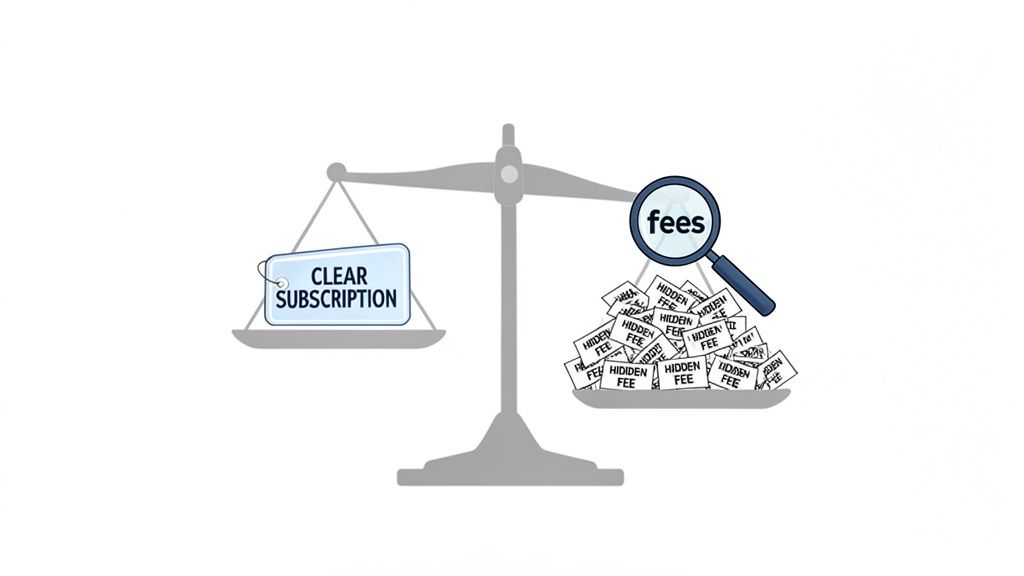
Choosing a platform to sell online courses can feel like trying to decipher intentionally confusing pricing models. It’s hard to know what you'll actually pay.
Let’s clarify. There are two main ways these platforms charge, and understanding the difference is key to your profitability.
The first model is the “free” plan. You pay nothing to start, but the platform takes a significant cut of every sale—often as high as 10%. It’s a low-risk option when you have no revenue.
The second is the paid subscription plan. You pay a fixed monthly fee, such as $99 per month, for platform access. In return, they take a much smaller percentage of your sales, typically around 1.5%. The upfront cost may seem intimidating, but it often becomes the more cost-effective choice much sooner than you think.
Free Plans vs Paid Subscriptions
Think of it this way: the "free" model is like paying rent based on your income—the more you earn, the more you pay. A paid subscription is like a fixed-rent storefront; your costs are predictable, so as your business grows, you keep more of your profits.
The key is to identify the tipping point where a "free" plan becomes more expensive than a paid one.
The most expensive mistake a new creator can make is choosing a platform based on its starting price instead of its scaling cost. A "free" platform can quickly become your biggest expense.
Let’s do the math. Imagine you’re selling a course for $199.
- On a free plan with a 10% fee, the platform takes $19.90 from every sale.
- On a $99/month plan with a 1.5% fee, the platform takes only $2.99 per sale.
After just six sales in one month, the "free" platform has taken more ($119.40) than the entire monthly cost of the paid plan. Every subsequent enrollment represents lost profit handed over to high fees.
Spotting the Hidden Costs
Platform fees are just the beginning. The real budget killers are hidden costs not advertised on the pricing page. These are essential features that come with a surprise price tag.
Watch for these common extra costs:
- Video Hosting Limits: Some platforms limit video storage on cheaper plans, forcing an upgrade as you add more content.
- Email Marketing Integrations: Basic email tools may be included, but connecting to services like ConvertKit or Mailchimp often costs extra.
- Premium Add-ons: Features like affiliate programs, advanced quizzes, or completion certificates are often locked behind more expensive tiers.
- Payment Processor Fees: Remember, platform fees are in addition to standard payment gateway fees from services like Stripe or PayPal, which are typically 2.9% + $0.30 per transaction.
To accurately forecast your expenses, map out your costs at different revenue levels. The "free" plan is rarely the cheapest option once you start making sales.
This table compares the total monthly cost of a "free" plan with a 10% fee against a paid plan with a much lower transaction fee.
Cost Comparison Free vs. Paid Platform Plans at Scale
| Monthly Revenue | Cost on 'Free' Plan (10% Fee) | Cost on '$99/mo' Plan (1.5% Fee) | Monthly Savings with Paid Plan |
|---|---|---|---|
| $1,000 | $100 | $114 ($99 + $15) | -$14 |
| $2,500 | $250 | $136.50 ($99 + $37.50) | $113.50 |
| $5,000 | $500 | $174 ($99 + $75) | $326.00 |
| $10,000 | $1,000 | $249 ($99 + $150) | $751.00 |
As the numbers show, the "free" plan is only cheaper at the very beginning. As soon as your business gains traction, the high transaction fee eats into your profits. A predictable paid plan quickly becomes the more profitable choice.
Common Mistakes to Avoid When Launching Your Course
A successful launch is more than clicking "publish." Many creators invest months building the perfect course, only to have their launch fail. This is often due to a few avoidable strategic mistakes.
Here is a practical guide on how to sidestep these common pitfalls so your course gets the students it deserves.
Building in a Vacuum Without Validating Demand
The biggest mistake is creating a course without confirming that anyone wants to buy it. A creator spends months perfecting every lesson, only to be met with silence on launch day.
Creating a course without pre-selling is like building a bridge with no river to cross.
What to Do Instead: Pre-sell your course. Before you record a single video, create a sales page that outlines the transformation students will achieve and offer an early-bird discount. This simple step validates your idea, provides cash flow for development, and builds a group of founding members who will give you invaluable feedback.
Pre-selling isn't just a sales tactic; it's your most important form of market research. It answers the critical question, "Will people pay for this?" before you commit months of your life to building it.
Treating Community as an Afterthought
Another common error is adding community as an afterthought. Many creators choose a platform to sell online courses based solely on content delivery, planning to start a separate Facebook group later. This fragments the student experience and hinders engagement.
Today's learners want interaction and support, not just information. The market for community-based Learning Experience Platforms (LXPs) is projected to grow at a compound annual growth rate of 33.8%, signaling a clear demand for social learning.
What to Do Instead: Integrate community into your course from day one. Choose an all-in-one platform where lessons, discussions, and live events coexist. When everything is in one place, students can easily connect and support each other, which dramatically boosts completion rates and long-term engagement.
Having No Onboarding or Marketing Plan
Finally, many launches fail due to the lack of a clear plan for what happens after someone buys. A confusing onboarding process can diminish a new student's excitement. Without a solid marketing plan, you won't reach enough of the right people.
A launch is a sustained campaign, not a single event. You need a strategy to attract leads, build trust, and welcome new students in a way that makes them feel supported.
What to Do Instead:
- Design a Smooth Onboarding Experience: Create an automated welcome sequence with a personal welcome video, a platform tour, and clear instructions on how to start.
- Develop a Multi-Channel Marketing Strategy: Build buzz for weeks before launch day with email marketing, social media content, and a free workshop or webinar to grow your email list.
- Use Early Feedback to Iterate: Treat your first students like co-creators. Actively solicit their feedback on the content and platform, and use their insights to improve your course.
Before getting lost in platform features, understanding the best practices for online courses can save you from significant headaches. By avoiding these common mistakes, you set your course up for a successful launch and long-term growth.
Your Final Checklist for Choosing a Platform
Choosing the right home for your online course is a major business decision that will impact your long-term success. You've reviewed the features, pricing, and common pitfalls. Now, let’s consolidate this into a final checklist to help you make a confident choice.
Use these questions as a final filter. If you answer "no" to any of them, it's a red flag that the platform may not be the right fit for your goals.
Monetization and Pricing
How you get paid is crucial. Don't be swayed by a low starting price; understand how fees will affect your profitability as you scale.
- Can you sell your courses in all the ways you want (e.g., one-time payments, subscriptions, bundles, payment plans)?
- Are the transaction fees transparent and fair, or will they consume a growing percentage of your revenue?
- Have you calculated your total monthly cost at different revenue levels ($1,000, $5,000, $10,000) to see the platform's true price?
- Are there hidden fees for essential features like video hosting, email integrations, or completion certificates?
Community and Engagement
Content is not enough. Community is what keeps students engaged and drives results. Your platform should make building that community seamless, not an afterthought.
When a platform lacks built-in community tools, it forces you to split your students' attention between your course and a separate Facebook group or Slack channel. That split creates friction, kills momentum, and makes it way harder for people to succeed.
- Does the platform have native community spaces like forums, member DMs, and profiles built-in?
- Can you host live events like Q&As or workshops directly within the platform?
- Does it offer gamification tools like badges, points, or leaderboards to keep students motivated?
Scalability and Your Future
Choose a platform for the business you want to have in three to five years, not just the one you have today. The right platform is a partner that grows with you.
- Will the platform perform well when you have thousands of students and dozens of courses?
- Does it offer advanced tools like affiliate marketing or in-depth analytics that you might need later?
- Most importantly, can you easily export your student data and content if you ever decide to move?
By working through this checklist, you can move past the marketing hype and make an informed decision. The right platform doesn't just host your videos; it acts as the engine for a durable, profitable education business.
Frequently Asked Questions
You've done the research and narrowed your options, but a few questions may remain. Let's address some of the most common concerns course creators have before making a final decision.
Can I Switch Platforms Later If I'm Not Happy?
Yes, but it is a difficult and time-consuming process. Migrating your students, their payment information, and your entire content library is a major project that requires careful planning and technical expertise.
It is far easier to choose a platform to sell online courses that can grow with you from the start.
Before committing to any provider, ask about their data export policies. A creator-friendly platform will always provide a straightforward way to download your student lists and course content. This gives you an exit strategy, ensuring you are never locked in if your business needs change.
Do I Need My Own Website to Use a Course Platform?
Not usually. Most all-in-one platforms provide the tools you need to build a professional website and sales pages directly on their system. You can run your entire business from a single dashboard.
That said, nearly every platform integrates with existing websites, such as a WordPress blog. This allows you to embed a checkout button on a blog post or link from your main site to your course sales page, giving you the best of both worlds.
The bottom line is this: an all-in-one platform provides a complete solution from day one, but it won't prevent you from using other marketing channels you've already built.
How Much Should I Expect to Pay in Transaction Fees?
Fees vary significantly between platforms. Be cautious with "free" plans, as they often have the highest transaction fees, sometimes taking 10-15% of every sale.
Platforms with a monthly subscription fee typically have much lower transaction fees, usually between 0% and 5%. This is in addition to standard processing fees from services like Stripe or PayPal, which are generally around 2.9% + $0.30 per transaction.
Before you commit, do the math. Calculate your potential costs at different sales volumes. A platform with a monthly fee may seem more expensive upfront, but it almost always becomes the more profitable choice as your business grows.
Ready to build, market, and sell your courses and community all in one place? Kampunity provides the integrated tools you need to turn your expertise into a thriving business without the technical headaches. Stop juggling multiple tools and start building your learning community today. Get started with Kampunity.